You have a great product, and your business model is spot on, but you can’t seem to keep a customer for longer than one visit. What could the problem be? The solution likely resides in your generic follow-up emails and late reminders.
Enter lead nurturing automation to the rescue. It’s an excellent pick for businesses that strive for efficiency and personalization throughout their sales funnels.
Today’s marketers understand the importance of automating sales and marketing; it’s more necessary than ever before. In fact, 57% believe that lead nurturing is the most important automation feature.
Lead Nurturing Automation Explained
A prospect comes to your B2B SaaS company site, and fills out the “try for free” form, opting into an automated workflow. They immediately receive a welcome email with a quick setup checklist. Over the next few weeks, the system sends tips highlighting key features they haven’t used and other helpful content, instead of generic sales messages.
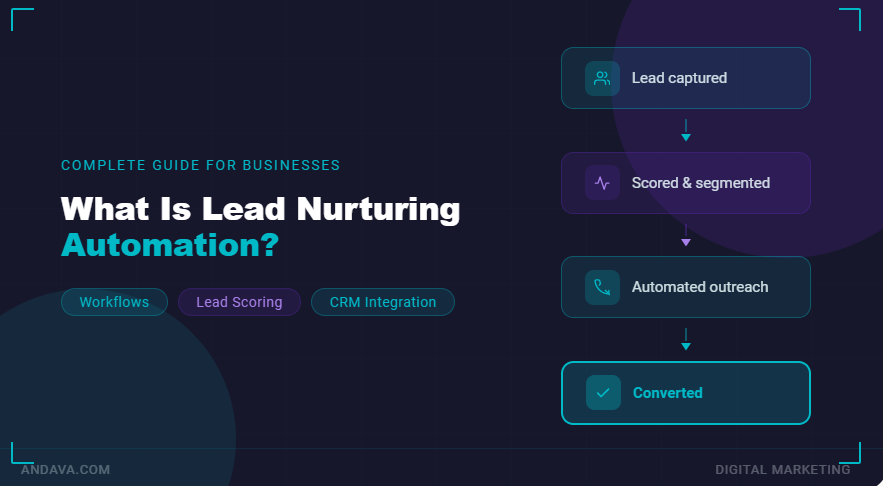
When the visitor completes a core action, like inviting a teammate, they automatically receive a use-case email showing how teams get value faster. This way, automation guides leads based on what they do, helping them move from interest to purchase without manual chasing.
Automated lead nurturing replaces manual work by handling repetitive tasks such as follow-up emails, event reminders, cart-abandonment sequences, onboarding messages, and anniversary communications.
Manual Lead Nurturing vs Automated Workflows
Recent studies suggest mid-to-large businesses generate just 5,000 or fewer leads monthly. Concerningly, roughly 80% of those new leads never convert. The good news is, automated workflows are creating new possibilities in lead nurturing that manual processes simply can’t.
✕
✓
✕
✓
- Speed:With manual lead nurturing processes, 41% of marketers admit they struggle to chase leads quickly. Automation solves this with the ability to immediately respond to the key visitor actions and provide timely follow-ups.
- Consistency: Manually chasing leads means that messages to a single prospect vary by team member, workload, or memory, leading to mistimed or skipped steps. That’s why 61% of marketers say generating high-quality leads is their biggest problem. Whereas, automated workflows ensure each prospect receives the same structured journey.
- Scalability: Manual nurturing is serviceable if you have a small number of leads. As lead volume grows, follow-up quality may drop, and costs rise as you add staff to meet demand. Lead nurturing software, meanwhile, can handle hundreds or thousands of leads at once.
Understanding Key Terms
When applying lead nurturing to an automated marketing workflow, it’s important to clearly outline the point of focus. Many marketers make the mistake of using the terms “lead nurturing marketing automation” and “marketing automation lead nurturing” interchangeably. In reality, there’s a key difference between them.
- Lead nurturing marketing automation: This focuses on lead nurturing as the primary goal, with automation as the tool. It’s about using automation to run structured nurturing journeys while answering the question “How can automation help us educate and warm this lead over time?”
- Marketing automation lead nurturing: This focuses on the general marketing automation system, with lead nurturing as one of its functions. It makes nurturing part of a larger automation ecosystem, and answers the question “How does lead nurturing fit into our broader automation setup?”
Why Businesses Need Lead Nurturing Automation
Manual lead nurturing might sound cheaper, but it often results in inefficiencies, delays, and human error that hurt your bottom line in the long run. Automation eliminates those risks and time-consuming workflows and creates consistent processes across teams. And that’s not all it does:
- Improves efficiency and scalability
- Enhances customer experience through timely and personalized communication
- Aids accurate segmentation and targeting using behavioral and demographic data
- Streamlines workflows through CRM and marketing platform integrations
- Produces stronger growth and ROI potential
It also aligns sales and marketing by giving both teams shared visibility into lead activity, standardized data they can trust, and a clear, automated handoff process. Since marketing and sales work from the same system, everyone can see how leads engage, how they’re scored, and where they are in the journey.
Foundations of Lead Nurturing Automation
The most effective lead nurturing automation strategies begin with proper planning. These foundational elements are the basis of any high-converting automation process.
- Understanding buyer personas and journeys: Create a buyer persona based on your ideal client profile (ICP), detailing their goals, challenges, behaviors, and decision-making process. This helps marketing teams produce personalized outreach that resonates with that specific customer’s needs.
- Analyzing your sales cycles: First, evaluate sales cycle length by reviewing data to see how long different types of leads take to convert. Then, define decision stages by identifying the major steps buyers go through. Finally, identify key touchpoints that indicate movement between stages.
- Content strategy: Ensure prospects can access your content on all platforms. A well-diversified content mix should include emails, blogs, webinars, social media, SMS, and gated assets. Content should also evolve as buyers move through each stage of their journey.
Behaviours
Decision-making process
Personalised outreach
Blog
Webinars
Social media
SMS
Gated assets
In the awareness stage, provide educational and non-promotional content that helps the buyer understand a problem or opportunity. When they develop an interest, content can introduce solution approaches that help them explore possible ways to address their needs. Once they enter the consideration and evaluation stages, content should become more specific and confidence-building.
Key Pillars of Lead Nurturing Automation
These are the techniques that unlock the full potential of marketing automation. Understanding these pillars will help you not only convert more prospects but also keep them coming back long term.
- Segmentation and Lead Scoring:This involves sorting leads based on certain criteria, like demographic fit and behavior, and ranking them based on how likely they are to convert.
- Personalization and Targeted Content: Delivering content that matches each customer’s niche, buying stage, or intent level is essential. In fact, 81% of people prefer companies that provide a personalized customer experience.
- Automation Workflows: Create rule-based sequences that automatically trigger actions based on user behavior, data, or timing. They guide leads through steps like sending emails, assigning scores, updating CRM records, or alerting sales.
- Behavior Tracking and Data Analytics:Tracking prospect behavior and data analytics in digital marketing helps you know if your strategies are actually working as intended. It’s important to keep your outreach helpful and relevant for prospects.
- Customer Profiling and Progressive Data Collection: Profiling entails building a clear picture of a lead’s characteristics, needs, and intent using available customer data. Gathering that information gradually, instead of all at once, enriches the profile, reduces friction, and allows for more personalized nurturing as the relationship grows.
Pillar 01
Pillar 02
Pillar 03
Lead scoring
CRM updates
Sales alerts
Pillar 04
Pillar 05
Choosing the Right Lead Nurturing Automation Platform
Selecting a lead nurturing automation platform starts with understanding not just what your business needs today, but also what it will need as it grows over time. Here’s what you should consider.
- Cost: This is the most obvious factor, but cheaper doesn’t necessarily mean better value. Entry-level tools might be affordable, but lack advanced features that enterprise platforms have to justify their higher pricing.
- Core features: Ensure that the chosen platform has the essential features you need, such as strong email automation, landing page builders, segmentation, and lead scoring that reflects buying intent.
- Integration capabilities: The platform should easily connect with your CRM, sales tools, and analytics stack to avoid data silos.
- Usability: Choose a platform that has intuitive workflows that reduce training time and ensure teams actually use the system.
- Customer support: Prioritize platforms that provide 24/7 customer support through call, email, or chat lines and verify their support responsiveness.
- Platform reputation: Review their onboarding resources and long-term customer feedback to find out what previous users think about the platform’s service delivery.
Each platform serves specific use cases and provides all required features. HubSpot is popular with growing teams that want an all-in-one, user-friendly platform. Marketo suits large B2B organizations with complex sales cycles, while Pardot works best for Salesforce-centric B2B teams.
Salesforce Sales Cloud is great when sales-to-marketing alignment is the priority. Keap is used by small businesses needing a combination of CRM and automation, while AWeber fits simpler email-focused nurturing for small teams.
Choosing the right digital marketing services depends on matching platform strengths with your sales strategy, team size, and growth goals.
Steps to Automate Your Lead Nurturing Process
Ultimately, marketing lifecycle automation is designed to guide prospects’ online interactions with your business by consistently providing content that matches their specific buyer intent. Here’s the step-by-step process of how you can adopt marketing automation for your business.
1. Understand Your Buyer and Define Goals
The first things to do are to clarify who your prospects are and what success looks like at each stage for your business. Define your ICP, understand what their challenges could be, and set a benchmark for each stage, whether that may be booking a demo, starting a trial, or becoming sales qualified. With these goals outlined, your workflow becomes focused and measurable.
2. Gather and Analyze Data
Next, review your existing data across forms, web activity, email engagement, CRM records, and product usage. These insights will give you a better idea of intent signals and gaps in understanding, helping you decide which behaviors should trigger automation and personalization.
3. Map the Customer Journey and Plan Content
Visualize how leads would usually move through the marketing lifecycle, and align valid content with each stage. For instance, educational resources support early interest, while case studies and ROI-focused content guide later decisions. Consider adopting AI assistance on this step. AI in marketing statistics suggests that 71% of marketers trust AI for personalized content creation.
Stage benchmarks
Goal setting
Web activity
Intent signals
Stage-aligned content
AI assistance
By industry
By intent stage
Sales alerts
Sales-ready thresholds
Timing optimisation
Performance data
4. Build Segmented Workflows
Segmentation helps you avoid the one-size-fits-all nurturing trap. Group leads by their job role, industry, behavior, or intent stage, and then build workflows that adapt to their engagement patterns. With segmented workflows, you can keep your messaging relevant even as your lead volume grows.
5. Set Up Lead Scoring and Prioritization
Set up a lead scoring system that combines your ICP with customer behavior to identify leads that are actually sales-ready. With automation, you can increase scores based on meaningful customer actions and notify your sales team when goals are met.
6. Test and Optimize
Finally, remember that automation is an ongoing process. To improve your workflow over time, test and refine your subject lines, timing, content formats, and scoring rules, based on performance data. Optimizing your process continuously keeps your nurturing effective as your business goals and buyer behavior change.
Best Practices for Lead Nurturing Marketing Automation
Effective lead nurturing automation depends on how, when, and to whom content is delivered. Here’s what’s needed to build a conversion pipeline the right way.
- Define clear goals and KPIs aligned with business outcomes. Whether that’s to increase sales-ready leads or shorten the sales cycle, clear KPIs help to keep your automation focused.
- Segment leads by behavior, persona, and funnel stage. This makes nurturing feel personalized and timely instead of just generic.
- Use a conversational, human tone rather than sales-heavy messaging. This lets prospects know you prioritize guidance over service, which is especially important in early stages where trust and credibility matter most.
- Focus on high-quality, value-driven content that answers a real question or solves a problem at every automated touchpoint. Educational insights, practical examples, and clear explanations beat sales-heavy messaging.
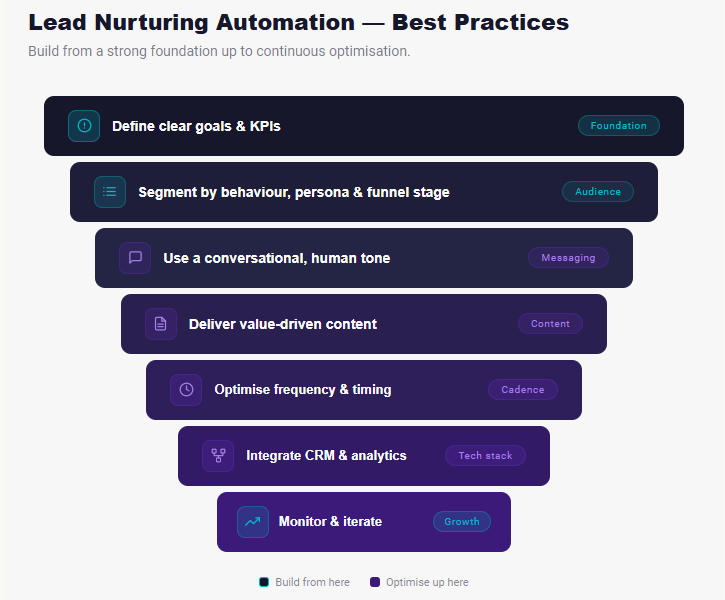
- More messages don’t equal better results, so optimize content frequency and timing to prevent fatigue. Use engagement data to properly space communications and adjust timing based on lead behavior to keep interest high without overwhelming inboxes.
- Ensure seamless integration across CRM, automation, and analytics tools. Clean integrations lead to accurate scores, smoother handoffs, and better collaboration between all your teams.
- Monitor performance and iterate regularly. Remember, automation is an evolving system, so review engagement, conversion, and drop-off points regularly. Use those insights to refine workflows, content, and scoring rules to ensure they’re aligned with changing buyer behavior and business goals.
Lead Nurturing Automation in Account-Based Marketing (ABM)
Automated lead nurturing in ABM targets the stakeholders in a target account. Unlike general automation, which engages and segments a wide variety of prospects, ABM automation might target employees in a specific company. Content is then personalized based on each employee’s position or decision-making influence within that company.
Within a target account, key decision-makers might receive ROI and strategic content, while technical users receive product details or implementation guidance. All of this is triggered automatically based on engagement and account activity.
This method of lead nurturing is especially useful in B2B marketing automation, where long sales cycles, high deal values, and multiple decision-makers are more common.
Manual vs. Automated Lead Nurturing: A Comparison
Let’s take a clear look at how manual and automated lead nurturing stack up against each other.
Does automation require an initial setup and clean data to reference? Yes. But it makes up for that by delivering greater long-term efficiency and growth than manual processes.
Automated lead nurturing is a necessity today for businesses looking to optimize their marketing strategies, attract more prospects, and scale their business as efficiently as possible. It takes a heavy load off your marketing teams, allowing them to focus on more strategic, forward-thinking solutions for your business.
With proper buyer analysis and segmentation, well-defined KPIs, person-level content strategy, and frequent pre- and post-launch testing, you can develop a conversion pipeline that aligns with your goals and buyer environment. Combining automation and lead nurturing improves your marketing potential and gives your prospects a truly memorable experience.