If you are not in the Big Four of accounting firms, you must work hard to build credibility for your services.
With around 138,000 accounting companies in the US and around 1,490,000 accounting firms worldwide, you face tough competition vying for your target audience’s attention.
Your potential customers need to find your website before they can become clients, and that means showing up when they search for SEO for accountants, SEO for CPA firms, and the dozens of variations people actually type into Google.
Because accounting touches people’s finances, Google holds this content to a higher trust bar than most industries (what Google calls YMYL — “Your Money or Your Life” content). That means the firms that rank well aren’t just doing SEO, they’re proving real expertise while they do it. This guide covers both.
What Is SEO for Accountants and Why It Works Differently
SEO for accountants shares the same core mechanics as SEO everywhere else, but it carries extra weight. Financial content sits in Google’s YMYL category, local intent is stronger (most searches include a city or “near me”), and the language has to stay accurate and compliant. The three-step process is still the same one every website relies on:
- You publish a website with relevant content and high technical performance
- Search engines crawl the web and find your site, matching you with the keywords and terms people use
- You get a good ranking based on the search engine’s algorithm: the more relevant your site is to the user’s query, the higher it will show
| ⚠ YMYL — Google applies higher scrutiny to financial content |
|
|||||
|
↓
|
|||||
|
|||||
|
↓
|
|||||
|
|||||
|
The Key Components of SEO for Accounting Websites
Imagine your website and Google’s search results are two ends of the same system. SEO is the connecting mechanism, much like an HDMI cable links a device to a TV. Only when the technical elements are properly aligned can your website be seen and understood by Google.
Finding the Right Accounting Keywords
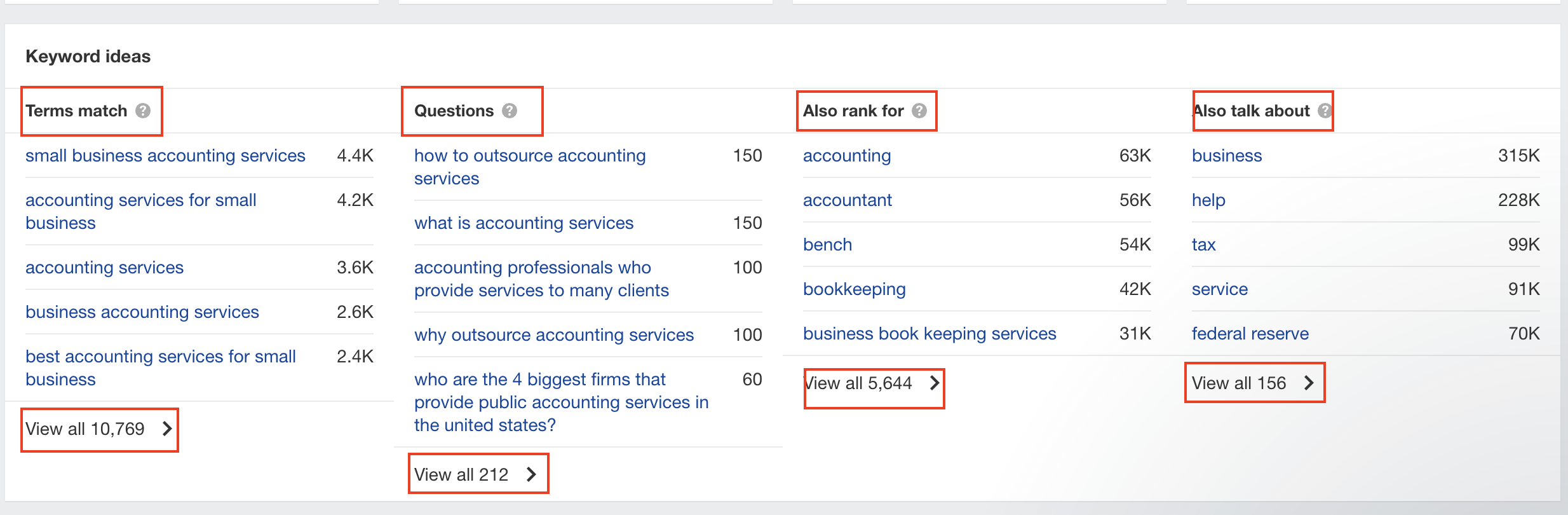
Keywords are the phrases people use to describe to Google what they want. If your website’s content addresses both what’s relevant to your customers and the keywords your target audience is actually searching for, the first cornerstone of SEO is set.
Keyword research is straightforward with the right tools, both paid and free. You enter the broad topic of your website, and the tool generates a list of relevant keywords to choose from.
The real work starts when you filter that list down. Writing content for every keyword your audience searches is not practical and rarely produces results. Search intent, covered next, is what tells you which keywords are actually worth targeting.
Beyond broad terms, look for long-tail keywords specific to your niche, phrases like “bookkeeping for e-commerce sellers” or “tax planning for self-employed contractors.” These get less volume individually, but they attract people who are further along in deciding to hire someone, which usually means better conversion rates.
Google Search Console is worth checking here too. It’s free, and it shows you the exact queries people are already using to find your site, including ones you haven’t intentionally targeted yet.
Matching Search Intent for Accounting Clients
The search intent is the intent users have when searching for something.,When someone searches “accounting services for small businesses,” they’re looking for firms suited to small business budgets and specifics, not a large-scale firm with Fortune 500 case studies.
If they land on a big enterprise-focused accounting firm in response to that query, it’s not what they were looking for, and it’s unlikely to convert.
The verdict: you do not need to optimize for “accounting services for small business” if you don’t actually target small businesses.
Choose keywords that:
- align with your target audience
- match what you offer
- reflect the search intent of your potential customers
Build your keyword list around these three factors, and every piece of SEO work that follows will pull in the right direction.
On-Page and Off-Page Optimization
These two core SEO directions work together to bring results.
On-page SEO covers everything inside your website that makes it easier for search engines to read:
- optimizing page titles and meta descriptions
- using proper heading tags
- improving website speed
- creating quality content
- removing duplicate content
- using alt tags for images
- implementing schema markup
- optimizing for Core Web Vitals and mobile-first indexing
- structuring content around technical SEO fundamentals like crawlability, site architecture, and HTTPS
Off-page SEO covers everything outside your website that still impacts your ranking:
- building backlinks from other websites
- improving brand reputation and online presence
- promoting your website through social media channels
- creating shareable content
- getting listed on business directories and review sites
On-page SEO ensures your site passes Google’s quality bar. Off-page SEO actively builds the authority that helps you rank higher once you’re there.
|
VS
|
|
Local SEO for Accounting Firms
Local SEO matters even more for accounting firms than most niches. It’s the tactic you use if you have a physical location and want to target customers within a specific geographic area.
With local SEO, you optimize for “near me” searches, use location-specific keywords in your content, and build citations on local business directories.
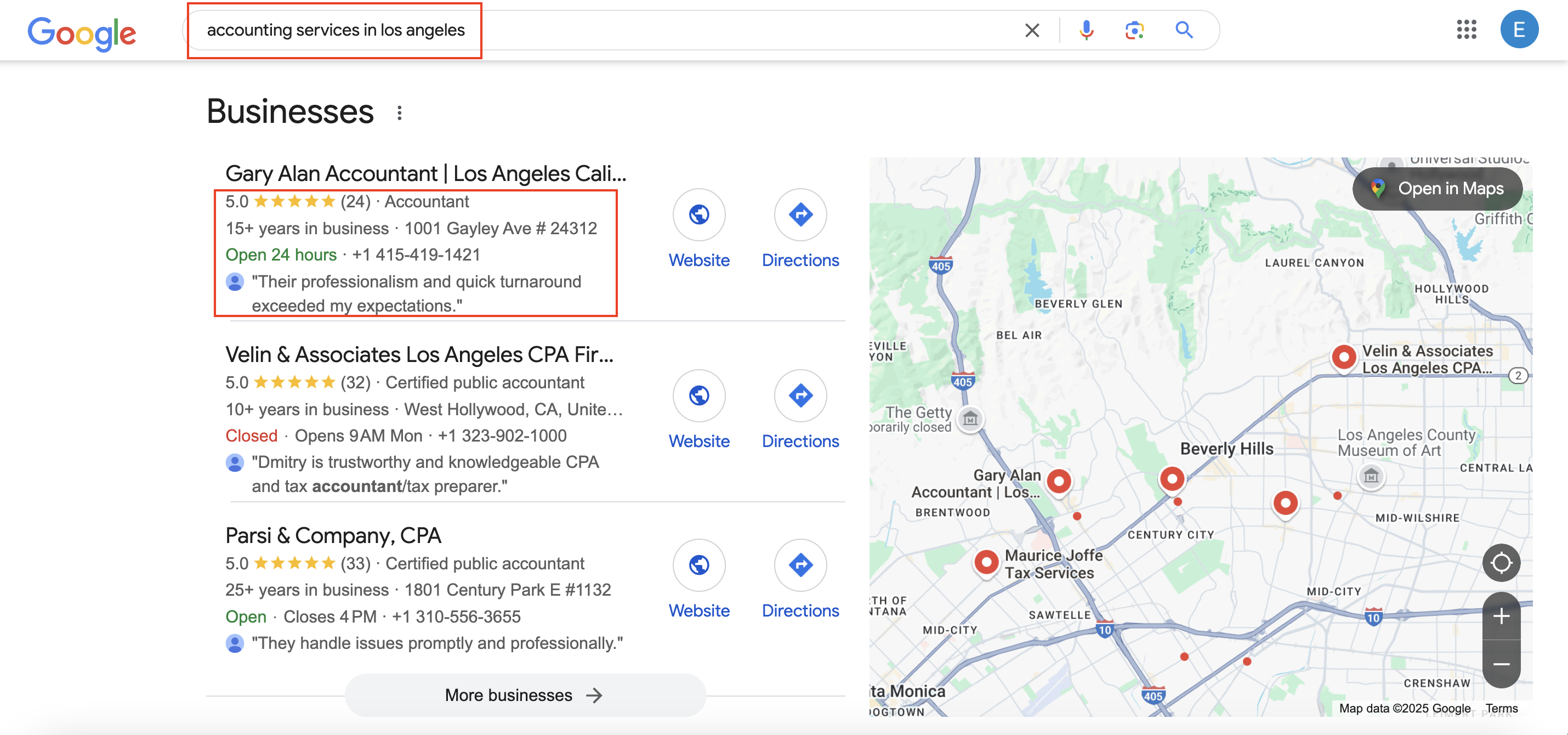
In SEO for accountants, this extra layer of geographic targeting is what determines whether your firm shows up when someone in your area searches for accounting services. For example, Gary Alan Accountant shows up first when someone searches “accounting services in Los Angeles” or similar terms.
The vast majority of people in that neighborhood interested in accounting services will call, visit the website, drop by the office, or save the contact information for later. That’s the power of local SEO.
Setting Up Your Google Business Profile
Your Google Business Profile is often the first thing a prospective client sees, before they ever visit your site. Make sure it has the correct primary category (such as “Accountant” or “Tax preparation service”), a consistent name, address, and phone information that matches your website exactly, real photos of your office or team, and regular posts about services or updates. Incomplete or inconsistent profiles are one of the most common reasons accounting firms don’t show up in the local map pack.
Building Local Citations
Beyond the directories mentioned later in this guide, get your firm listed on Yelp, Clutch, and your local Chamber of Commerce site. The goal is consistency: your firm’s name, address, and phone number should read identically everywhere it appears online.
Getting and Managing Client Reviews
Google reviews are a direct local ranking factor and a trust signal for anyone comparing firms. Ask satisfied clients for a review right after a good outcome, a completed filing, a resolved audit, a smooth tax season, rather than waiting and hoping they’ll think of it later.
How Much SEO Costs and What Return You Can Expect
Most businesses spend between $500 and $5,000 on SEO per month. Given that even basic bookkeeping services often cost between $300 and $2,500 a month, you have a strong chance to pay off that investment quickly.
Roughly calculated, if you get 2 clients per month from SEO and retain them for a year, you’ll earn between $7,200 and $60,000 in revenue. That’s close to a 100% return on investment in the first year alone.
With consistent SEO effort, most firms don’t stop at 1-2 clients a month. Results aren’t immediate, but once you’re holding stable rankings across a healthy set of keywords, organic traffic becomes a consistent source of new leads.
12 Proven SEO Tactics for Accounting Firms in 2026
With basic SEO knowledge and the right tools, you can start this process yourself and scale later. If you’re serious about results, hiring an experienced SEO specialist or agency means every dollar spent is directed toward your goals faster.
Write Strong Site and Meta Descriptions
Once your accounting website is live, your site description should mention what services you offer, where you’re based, and the benefit of working with you.
Here’s the site description of Raben CPA, a CPA firm in Las Vegas:
Once you start publishing service pages and blog posts, every one of them needs its own meta description. The site description is broad; page descriptions should be specific and use narrower keywords.
Choose Keywords With the Right Intent, Not Just Volume
“Tax help” might look like a perfect keyword for tax preparer SEO since it has real search volume. But it’s too broad, the searcher intent is unclear, and most government websites already dominate the first page for it.
Go more specific instead. Add a location (state, city) or additional qualifiers like “for small businesses” or “for self-employed.”
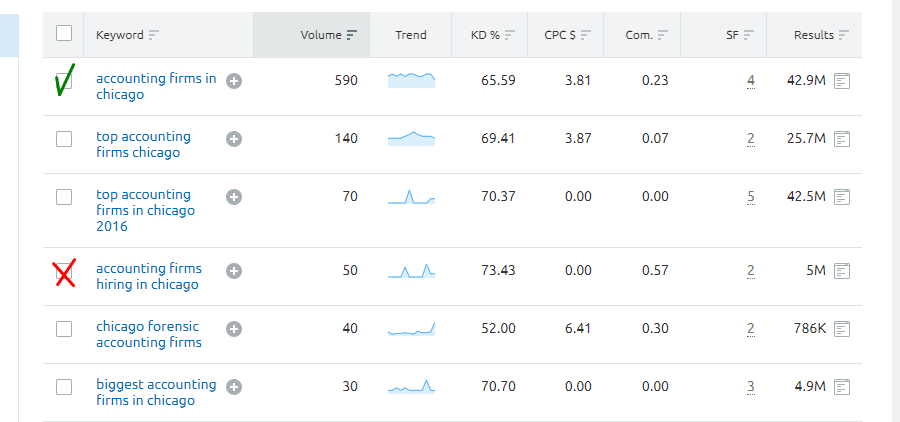
For example, typing “accounting firms in chicago” into a keyword tool returns a list, but not every suggestion is worth targeting. “Accounting firms in chicago” could make a great blog post if you’re based there. “Accounting firms hiring in chicago,” on the other hand, is searched by jobseekers, not clients, and isn’t worth your time.
Build Links Through Directories, Guest Posts, and Broken Link Outreach
When you’re first building your firm’s online reputation, links don’t come easily. Start by submitting your website to high-quality directories.
CPA Tax Accountant Firm Finder is one of many sites that link to accounting firms and help people find a service provider in their area.
TaxBuzz is another option, though it’s focused on listing individual professionals rather than firms, making it more suited to accountant-level SEO.
Guest blogging is another effective way to build links. The best place to publish guest posts is on the blogs of SaaS companies that offer accounting software. They’re not your competitors, but they cover similar topics, which makes them a natural fit for a link.
Broken link building is another underused tactic: find pages on accounting or small-business sites where a link has gone dead, and offer your own relevant content as the replacement. It takes less effort than cold outreach, because you’re solving a problem the site owner already has.
Define Your Target Client and Service Offer
Some businesses only want to work with CPAs, while others just need bookkeepers to track and organize transactions. Some need consulting on top of that, while others only need the numbers handled.
You need a clear picture of the services you offer and the buyer personas that come with them, and a clear picture of the industries you serve. ORBA, for example, works with dental, healthcare, law, manufacturing, real estate, restaurant, and nonprofit clients.
CapActix works across an even wider range, including agriculture, retail, e-commerce, and power generation.
This directly shapes your SEO copy. You can’t write search-optimized service pages if your service list isn’t already clear. Every button on CapActix’s site leads to a dedicated service page with its own keyword-targeted copy.
Fix Technical SEO: Speed, Mobile, and Core Web Vitals
Technical issues can undo all the work you put into your content. Common problems include:
- Your website isn’t secure (no HTTPS)
- The website isn’t mobile-optimized
- Your Core Web Vitals scores are failing (check with Google PageSpeed Insights)
- Your site isn’t passing Google’s mobile-first indexing requirements
- Meta descriptions are missing or duplicated across pages
- There’s duplicate content with no canonical tags
|
|||
|
|||
|
|||
|
|||
|
|||
|
Add Schema Markup to Help Google Understand Your Site
Schema markup is code you add to your site that tells search engines exactly what your content means, not just what it says. For accounting firms, LocalBusiness schema confirms your service area and hours, FAQ schema can surface your questions and answers directly in search results, and Organization schema reinforces who you are across the web. It’s a one-time technical setup with a lasting payoff.
Keep Your Content Updated
Google favors content that’s actively maintained over content left untouched for years. Revisit your key pages on a regular schedule: update statistics, add new examples, and note when the page was last reviewed. This guide itself is reviewed and updated regularly for exactly this reason.
Build Real Author Credibility Into Every Page
Pages about financial topics perform better when it’s clear a qualified person stands behind them. Include real credentials, certifications, or relevant experience in author bios, not just a job title. This matters more for accounting SEO than almost any other niche, since Google applies stricter quality standards to financial content.
Track Rankings, Traffic, and Conversions
Connect Google Search Console and Google Analytics before doing anything else on this list. Without them, you’re optimizing blind: you won’t know which keywords are bringing in impressions, which pages convert, or where visitors drop off. Set up conversion tracking for form submissions, calls, and consultation requests so you can tell which SEO efforts are actually generating clients.
GEO for Accountants: How to Show Up in ChatGPT, Perplexity, and AI Overviews
Search is splitting into two channels. There’s still the traditional blue-links Google results page, and now there’s a growing share of searches answered directly by AI tools: ChatGPT, Perplexity, Gemini, and Google’s own AI Overviews. Someone asking “how do I find a good CPA for my small business” might never see a search results page at all. They’ll get an answer, with a firm’s name already in it, or they won’t.
|
+
|
|
|
ChatGPT
|
Perplexity
|
Gemini
|
AI Overviews
|
Generative Engine Optimization (GEO) is the practice of making sure your firm is the one that gets named. It’s not a replacement for SEO, it’s built on top of it. The same signals that help Google trust your site (real expertise, clear structure, accurate information) are what AI tools pull from when they generate an answer.
Why This Matters for Accounting Firms Specifically
Financial questions are exactly the kind of thing people now ask AI tools instead of searching for: “what’s the difference between a CPA and a bookkeeper,” “how much should I expect to pay for small business tax prep,” “do I need an accountant if I use QuickBooks.” These are high-intent questions from people close to hiring someone. If an AI tool answers them without ever mentioning your firm, that’s a lead you never see and never know you lost.
How AI Tools Decide What to Cite
AI search tools are built to answer the underlying question, not to match keywords. That changes what “optimized” content looks like:
- Structure content as direct answers to real questions. A heading like “How Much Does an Accountant Cost for a Small Business?” gets pulled into an AI answer more easily than “Our Pricing,” because it mirrors how someone would actually phrase the question to ChatGPT.
- Cover one topic completely instead of splitting it across pages. A single, thorough guide on small business tax planning outperforms five shorter posts on adjacent topics. AI tools tend to pull from sources that demonstrate full coverage of a subject, not partial coverage repeated across multiple pages.
- Make expertise visible, not just implied. Named credentials, specific examples from real client work (anonymized where needed), and a clear point of view all signal the kind of trustworthiness AI models are trained to weight heavily, the same E-E-A-T signals Google already rewards.
- Keep facts and figures current and easy to extract. AI tools favor content with clearly stated numbers, dates, and definitions over vague or dated language. A stale “as of 2022” statistic is a red flag to both a reader and a model.
- Use structured data. Schema markup (Organization, FAQ, Article) gives AI crawlers a clean, unambiguous read on who you are and what your content covers, reducing the chance your content gets misread or skipped.
|
|||
|
|||
|
|||
|
|||
|
What This Looks Like in Practice
Say a prospective client asks ChatGPT: “What should I look for in a CPA for my e-commerce business?” A firm that has published a genuinely thorough, specifically-titled guide on accounting for e-commerce sellers, with real expertise and current examples, is far more likely to get named than a firm whose only relevant content is a generic “our services” page. The firm doesn’t need to have the biggest website. It needs to have the clearest, most complete answer to that exact question sitting somewhere on its site.
GEO Is Not Optional Anymore, but It’s Not a Replacement Either
Don’t drop traditional SEO fundamentals to chase this. AI tools still rely heavily on the same signals Google has used for years: technical soundness, authoritative content, real backlinks. GEO is a new layer on top of that foundation, not a different foundation. Firms treating it as an either/or are already behind; firms building both at once are the ones getting cited.
FAQ
How Much Does SEO Cost for an Accounting Firm?
Most businesses spend between $500 and $5,000 a month on SEO. Given that even basic bookkeeping services often charge $300 to $2,500 a month, landing just two clients from organic search and retaining them for a year can generate $7,200 to $60,000 in revenue, a strong return in the first year alone.
How Long Does SEO Take for a CPA Firm?
SEO is not immediate. Most firms start seeing meaningful movement in rankings and traffic within 3 to 6 months, with stronger, more consistent lead flow building over 6 to 12 months as more keywords hold stable positions.
Do Accountants Need Local SEO?
If you serve clients in a specific city or region, which most accounting firms do, local SEO is one of the highest-return tactics available. It’s how you show up in the map pack and “near me” searches, which make up a large share of accounting-related search traffic.