

Your advertising budget matters. Every dollar counts when you’re trying to grow your business online. Choosing the wrong platform wastes money. It also wastes time you could spend connecting with customers who actually want what you sell.
Facebook Ads vs Google Ads: This comparison isn’t about picking a winner. It’s about understanding where your business fits and which platform delivers the results you need right now.
Google Ads vs Facebook Ads: Core Differences
Think about how you discovered your last purchase. Did you search for it, or did an ad catch your eye while scrolling? That’s the fundamental difference between these platforms. Below are the key ways they differ.
- Paid Search vs. Paid Social: Google captures active searchers. Facebook interrupts passive browsers. Google meets demand that already exists. Facebook creates demand you didn’t know was there.
- User Intent vs. User Discovery: Someone typing “running shoes for flat feet” into Google wants running shoes right now. Someone scrolling Facebook at lunch might not need shoes until your carousel ad shows them something irresistible.
- Active vs. Passive Mindset: Google users hunt for solutions. Facebook users relax, browse, and discover. Understanding your audience’s mindset shapes your entire digital marketing budget allocation.
- Text-Based vs. Visual-First Formats: Google relies on headlines and descriptions that match search intent. Facebook thrives on images, videos, and stories that stop the scroll.
- Demand Capture vs. Demand Creation: Google Ads perform best when you already know that the people need what you sell. They prefer Facebook Ads more when you need to introduce something new or create long-term brand awareness.
- Immediate Conversions vs. Reach and Nurture: Google delivers faster sales. Facebook builds relationships that convert over time. Both have their place in a complete marketing strategy.
What is Google Ads?
Google Ads puts your business in front of people actively searching for what you offer. It’s the world’s largest pay-per-click platform, reaching billions of searches daily.
How Google Ads Works
Google Ads operates within the framework of keyword auctioning. You give keywords based on your trade. Whenever somebody makes a search containing this term, your advertisement can show. The following encapsulates the core components that detail how Google Ads works and produces results.
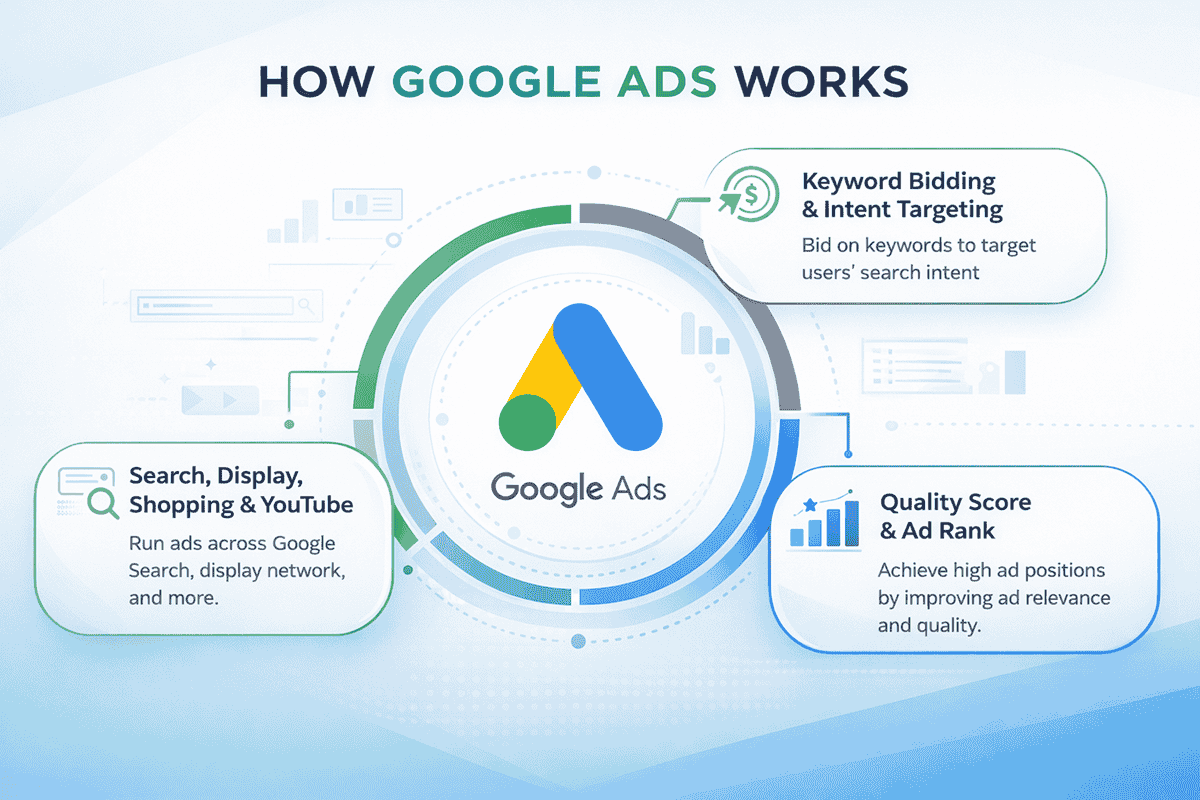
- Keyword Bidding and Intent Targeting: This is the bidding war against other competitors for placement of the ad. Of course, the higher you bid, the better, but then Google uses relevance to differentiate; Google’s Quality Score is what determines your actual cost and position.
- Search, Display, Shopping, and YouTube: Search ads show right up on the Google page you’re looking at when you search for something. Display ads pop up on millions of websites. Shopping ads have all the details (product image, price) so people can get a good idea of what they’re getting. Then there are YouTube ads, which show up before, during, and after videos.
- Quality Score and Ad Rank: Google looks at your ads and scores them based on how likely they are to get clicked, how relevant they are, and how well your landing page is set up. And the better your Quality Score, the less you’ll pay and the better position you’ll get. This levels the playing field; small businesses with great ads can outperform bigger competitors with larger budgets.
According to a study from Statista, back in 2023, Google brought in an eye-watering $264.59 billion in advertising revenue. That’s just a rough idea of how massive Google is and how advertisers just love the platform.
Strengths of Google Ads
Google Ads excels at capturing ready-to-buy customers. The platform’s strengths center on purchase intent and conversion power.
- High-Intent Users Ready To Take Action: When someone types in “emergency plumber near me” or goes and searches “buy noise-canceling headphones”, they’re not just browsing around; they’re actually looking to get something done. Google hooks you up with people like that at exactly the right moment.
- Strong Conversion Rates: Because searchers have clear intent, they convert faster. A 2024 WordStream Benchmarks Report found that the average conversion rate across all industries on Google Search Ads is 6.96%. This is significantly higher than on other social platforms, such as TikTok and LinkedIn.
- Scalable Bottom-Funnel Performance: Google Ads scales well as your business grows. You can expand to new keywords, increase budgets, and maintain performance. The platform handles increased spend better than most alternatives when targeting purchase-ready audiences.
- Captures Existing Demand: You don’t need to convince people they need your product. They already know. You just need to show up when they search. This makes Google ideal for businesses with proven demand and established product categories.
6.96% avg conversion rate
Weaknesses of Google Ads
Google Ads does have its flaws. Several of these flaws can hit your outcomes and your budget.
- High CPC in Competitive Industries: Keywords in sectors like insurance, gas/electricity, mortgages, and legal services often exceed $40 per click, with some even surpassing the $54 mark. Rising costs are starting to affect even mid-tier sectors like software, education, and healthcare, as competition intensifies.
- Requires Strong Landing Pages: The ad alone cannot maintain a customer’s conversion. If the job’s landing page can’t work, the ad budget goes to waste. Google Ads demands a highly positive post-click experience-with optimized landing pages, speedy page load times, clear CTA, and, lastly, a mobile-friendly layout.
- Limited Demographic and Interest Targeting: Google focuses on keywords and search behavior. While you can layer in demographics, age, gender, and location, you can’t target based on interests, life events, or detailed behaviors like you can on Facebook.
- Steeper Learning Curve. Google Ads is about searching for keywords, doing bids, improving the Quality Score, and continuous testing. This experience-based stage often wastes beginners’ budgets down the drain before they find a silver lining. Consider a professional Google Ads audit service if you’re struggling to see results.
What is Facebook Ads?
Facebook Ads pops up when people are just browsing, scrolling through their feeds, and engaging with content. It’s the biggest social advertising platform out there, giving you access to literally billions of users across Facebook, Instagram, Messenger, and WhatsApp.
How Facebook/Meta Ads Work
Facebook takes a fundamentally different approach than Google. Instead of keywords, Facebook targets people.
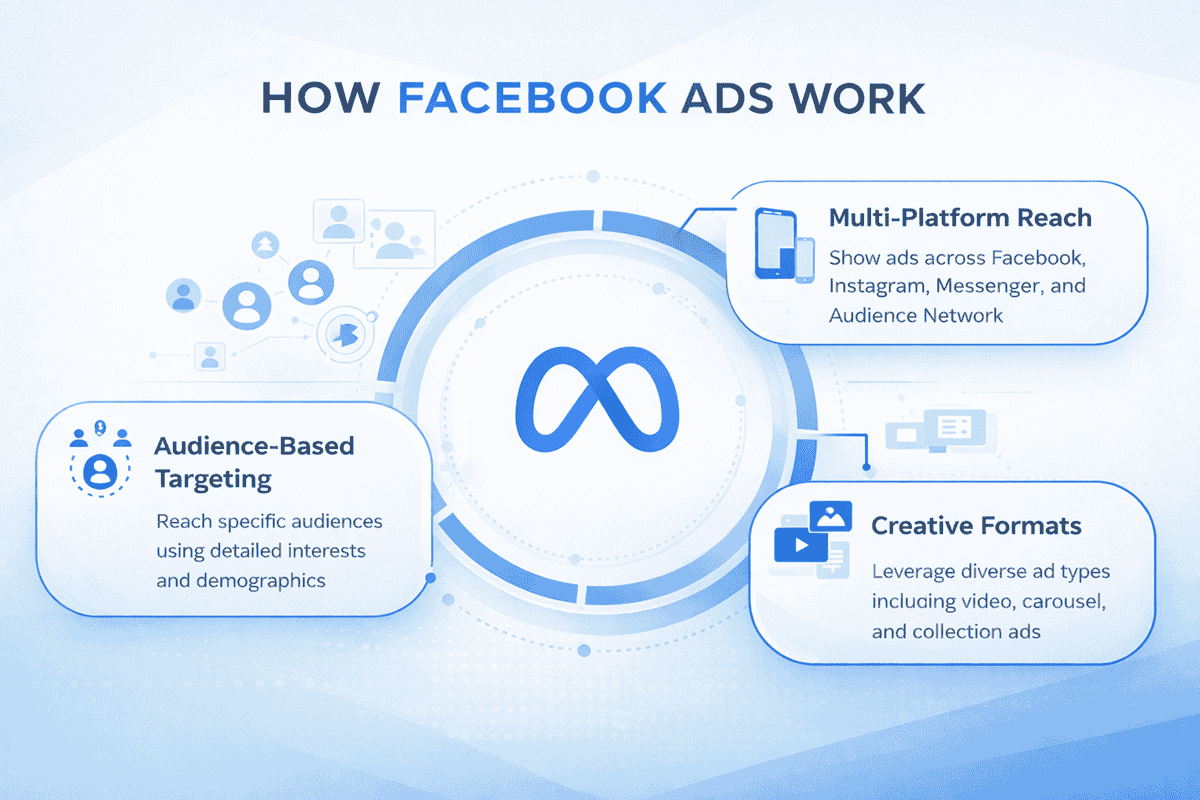
- Audience-Based Targeting: Reach specific users by demographics, interests, and behaviors: for example, new parents, pet owners who have moved, or people celebrating anniversaries. Facebook uses the content users share and engage with to deliver precise targeting.
- Multi-Platform Reach: Ads appear on Facebook, Instagram feeds and Stories, Messenger, and thousands of apps and websites via Meta’s Audience Network, reaching users across multiple touchpoints.
- Creative Formats: Facebook favors visual-first content, including images, videos, carousels, Stories, and interactive Collections that open into full-screen shopping experiences. The platform rewards creative, engaging ads that feel native to the feed.
Strengths of Facebook Ads
Facebook’s real power lies in precision targeting and visual storytelling. These strengths make it exceptional for specific marketing goals.
- Advanced Audience Segmentation: Target users by job title, life events, behaviors, devices, and more. Lookalike audiences help you find new customers who are similar to your best customers. Applying STP marketing principles helps maximize Facebook’s segmentation capabilities.
- Visual Storytelling and Engagement: Feeds favor images and videos, letting brands showcase products, tell stories, and build emotional connections.
- Lower CPC and CPM: Facebook ads cost less than Google, with an average CPC of $0.77 versus $4.66, making it ideal for smaller budgets and testing.
- Excellent for Brand Awareness and Retargeting: Facebook reaches new audiences, keeps brands top of mind, and retargets them with dynamic ads via Facebook Pixel.
Weaknesses of Facebook Ads
But despite its many strengths, Facebook ads also come with their fair share of major drawbacks that can actually do your campaign a lot of harm.
- Lower Purchase Intent: Users aren’t exactly shopping when they log into Facebook, so your ad is basically interrupting their relaxation time. That means lower conversion rates right off the bat compared to Google.
- Creative Fatigue: Ad fatigue can kill your ad performance in a hurry. To avoid this, you’ll have to keep testing new images, different copy, different ad formats, just to keep getting the results you want.
- Attribution Limitations: iOS privacy changes have made Facebook tracking less accurate, making it harder to measure true Return on Ad Spend (ROAS).
- Can Generate Unqualified Clicks: Broad targeting or weak creative attracts curiosity clicks from people who’ll never buy.
Cost Comparison: Google Ads vs Facebook Ads
Understanding the differences in the cost helps you prioritize your spending strategically when evaluating which is better, Google Ads or Facebook Ads.
Average CPC and CPM Differences
The difference in cost is pretty significant and, in general, consistent between Google Ads and Facebook Ads, regardless of industry.
- Google: Higher CPC, Higher intent: Google’s average cost-per-click sits around $4.66 across industries. Competitive sectors regularly exceed $6–$8 per click.
- Facebook: Lower CPC, Broader Reach: Facebook averages around $0.77 per click, making it roughly 84% cheaper than Google. You can reach more people for less money.
According to the 2024 WordStream Google Ads Benchmarks for Industries, B2B industries see Google CPCs averaging $3.33, while eCommerce averages $1.16.
In eCommerce, Google Shopping ads usually cost $1–$2 and attract high-intent buyers, who come to see or buy the product. When it comes to Facebook carousel or video ads, they tend to look for discovery buyers and impulse buying at $0.50–$1 per click. Many D2C brands use Facebook for awareness and Google to capture final conversions.
Budget Scaling and Flexibility
Both platforms can support daily budget caps as well as different bidding strategies. You handle spending and can pause campaigns at any time. Start small, test performance, then scale up the winners.
Google scales up by expanding keywords and increasing bids, whereas Facebook scales by broadening audiences and testing new creatives. Both platforms offer diminishing returns at larger scales.
Targeting Capabilities: Which Platform Wins?
Targeting determines who sees your ads. Different approaches suit different business models.
Keyword vs Audience Targeting
Everything else stems from the fundamental targeting differences.
- Google = Intent Signals: Keywords reveal what people want right now. For example, someone searching “best CRM for small business” actually wants to buy it right away.
- Facebook = Persona-Based Precision: Facebook targets people based on who they are, rather than what they might be searching for. Its demographics, interests, and behaviors define your audience.
Demographics, Interests, Behaviors
Facebook really has the edge when it comes to detailed demographic and behavioral targeting.
- Facebook’s Granular Targeting Power: With Facebook, you can select your audience with precision: location, life events, interests, behaviors, devices, and even competitor brands. The depth and flexibility are unmatched.
- Google’s Limited Demographic Targeting: Google Search basically relies on keywords with some basic filters like age, gender, location, and income. You can use stuff like customer match and similar audiences, but you need to have some existing customer data to make the most of it.
Advanced Targeting Tools
Advanced targeting options are available on either platform.
- Lookalike Audiences vs Similar Audiences: Facebook generates new customers with comparability to existing users. Google offers a generalized definition of Similar Audiences for comparison.
- In-Market Segments vs Interest Groups: Google targets its marketing to consumers looking to buy. Facebook uses behaviors and content to target users.
- Retargeting on Both Platforms: Google retargets search and site traffic, and Facebook retargets only its page views and purchases. Using both is beneficial for greater retargeting coverage.
Performance by Business Goal
Matching your objective to platform performance strengths improves results.
Higher intent · Higher cost per lead
Lower cost · Longer nurture cycle
For Lead Generation (B2B & B2C Services)
Lead generation performance varies significantly between platforms.
- Google: High-Quality Leads from Search Queries. When someone searches “marketing agency for SaaS companies,” they’re actively seeking help. Conversion rates are higher, though the cost per lead is also higher.
- Facebook: Lower-Cost Leads via Lead Forms. Facebook lead forms deliver affordable leads but often require longer nurturing than search-driven leads.
Google wins when leads need high intent and short sales cycles. Facebook wins when building awareness or targeting specific professional roles. Effective digital advertising services often integrate multiple platforms.
For E-Commerce and Direct Sales
eCommerce brands should strategically leverage both platforms.
- Google Shopping and High-Intent Search = Strong Conversions: Google Shopping ads average a conversion rate of about 1.9%, while traditional text Search ads often convert at lower rates.
- Facebook/Instagram = Product Discovery, Impulse Buys. Lifestyle imagery and video content introduce products people didn’t know existed. Dynamic ads retarget browsers with products they viewed.
Smart eCommerce brands recognize the value of retargeting: 20% allocate a dedicated budget, and 50% plan to increase investment.
Lower-priced items under $50 often perform better on Facebook through impulse purchases, while higher-priced products convert more effectively on Google, as buyers actively research before committing.
For Brand Awareness and Engagement
Building brand recognition requires consistent visibility and engagement.
- Facebook = Community, Storytelling, Viral Potential: Facebook and Instagram foster community through comments, shares, and user-generated content.
- Google Display/YouTube = Broad Reach But Less Social: Google Display Network reaches 90% of internet users across millions of websites, but doesn’t generate the social engagement that Facebook does.
Which drives long-term growth? Facebook excels at engagement and community building, while Google delivers sustained visibility and broad reach. Combining platforms (Facebook for social, YouTube for video, Google Display for awareness) maximizes brand-building impact.
Performance by Business Type
Your business model influences which platform delivers better results.
High intent
- →Captures active buyers searching for solutions
- →High-intent keywords like “enterprise software”
- →Best for bottom-of-funnel conversions
Supporting
- →Target by job title, company size, industry
- →Lower cost for awareness campaigns
- →Good for retargeting site visitors
B2B Companies
B2B purchases involve multiple decision-makers and lengthy evaluations. Google captures searches like “enterprise project management software”: clear signals of buyer intent. Facebook targets job titles, company sizes, and professional interests.
LinkedIn offers the most precise B2B targeting. Google captures active searchers. Facebook costs less and reaches business decision-makers. Many successful B2B strategies combine all three platforms.
eCommerce and Retail Brands
Retail businesses benefit from using both platforms strategically.
- Facebook/Instagram: Excels at visual storytelling, impulse buys, user-generated content, and broad reach.
- Google Shopping/Search: Captures high-intent buyers ready to purchase.
- Retargeting: Essential on both platforms for abandoned carts and viewed products.
Low-price items often perform better on Facebook, while higher-priced purchases convert more effectively on Google. The best ROI comes from combining both: Facebook for discovery and engagement, Google for conversions, and coordinated retargeting across the customer journey.
Local Businesses
Local businesses have unique advantages and challenges with each platform.
- “Near Me” Search = Google Dominance: Google leads as the top platform for reading reviews, with 83% of consumers using it, far ahead of local news sites (48%), Yelp (44%), Facebook (40%), and YouTube (34%).
- Community Engagement = Facebook/Instagram: The lifeblood of local businesses is community interaction. Facebook Events, local groups, casting a narrow net, and hyperlocal targeting help you create loyal customer bases.
Google is always at its best when it comes to anything localized. They can push ads everywhere based on the distances from your location. Facebook, on the other hand, is city and region-centric but does it with less precision.
When to Use Google Ads vs Facebook Ads
It’s all about choosing the right ad platform, and that depends on what you want to get out of it, how your target audience behaves, and what kind of budget you have. This is what drives the whole ad cost comparison and decision-making process.
High-intent searchers convert fast
Cheaper rates, massive visual reach
Low CPC lets you test with small budgets
Conversion rate beats cost-per-click here
Choose Based on Marketing Objective
Your goal right now should guide your choice of ad platform.
- Immediate Leads/Sales → Google: If a quick conversion is necessary, turn to Google. High-conversion searchers reach their high-conversion stage immediately.
- Rapid Reach/Brand Exposure → Facebook: Due to its comparatively cheaper rates and visual effects, it is ideal for creating brand awareness with a large population.
- Cheaper Testing → Facebook: Facebook generally offers low CPCs. This lets you test various messages, creatives, offers, and parts of your buying cycle with small investments.
- High-Intent Conversions → Google: When conversion rate matters more than cost per click, Google wins.
Choose Based on Audience Behavior
This is essentially predicated on where your audience spends the majority of their time and their subsequent actions.
- Actively Searching → Google: In instances where your clients are clear on their product category but are in need of solutions, Google is quite effective.
- Demographic or Interest-Based → Facebook: If the basis for your ideal client consists of their identity and not their search details, Facebook’s targeting offers a good portrait of your target market.
Choose Based on Budget Flexibility
Consider the funds needed for the selection of a platform.
- Very Small → Facebook First: With a budget of less than $1,000 per month, Facebook proves a comparatively cheaper way to achieve higher volume and test campaigns very economically.
- Medium/Large → Combine Both With the Funnel Strategy: A $3,000-5,000 monthly budget essentially calls for a multi-platform approach, where Facebook shall be used for top-funnel awareness, and Google shall be used for bottom-funnel conversions.
Final Thoughts
In the battle of Facebook Ads vs Google Ads, there is no clear winner. Both have their roles to play in a full-fledged marketing program.
Google excels in capturing high-intent demand from searchers already interested in purchasing. Facebook nurtures demand, guiding consumers from awareness to conversion through the power of discovery, storytelling, and targeted advertisements. Which platform wins depends on your objectives, customer behavior, and sales cycle.
Use data-driven tools to determine optimal spend allocation. Continuously test and shift the budget based on performance data. If unsure how to analyze results or scale campaigns, consult experts for Google Ads services or Meta advertising services.
The best results are seen when both platforms are combined using a clever strategy. Use Facebook to build brand awareness and Google to capture intent. Track everything and optimize continually.

