You’re publishing content. Your competitors are still outranking you. A content gap analysis tells you exactly why, and exactly what to fix.
Whether the gap is a missing keyword, an uncovered topic, a buyer-journey stage you’ve ignored, or a prompt where ChatGPT cites your competitor and not you, this guide walks you through how to find every type of gap and turn it into ranking content.
What Is Content Gap Analysis?
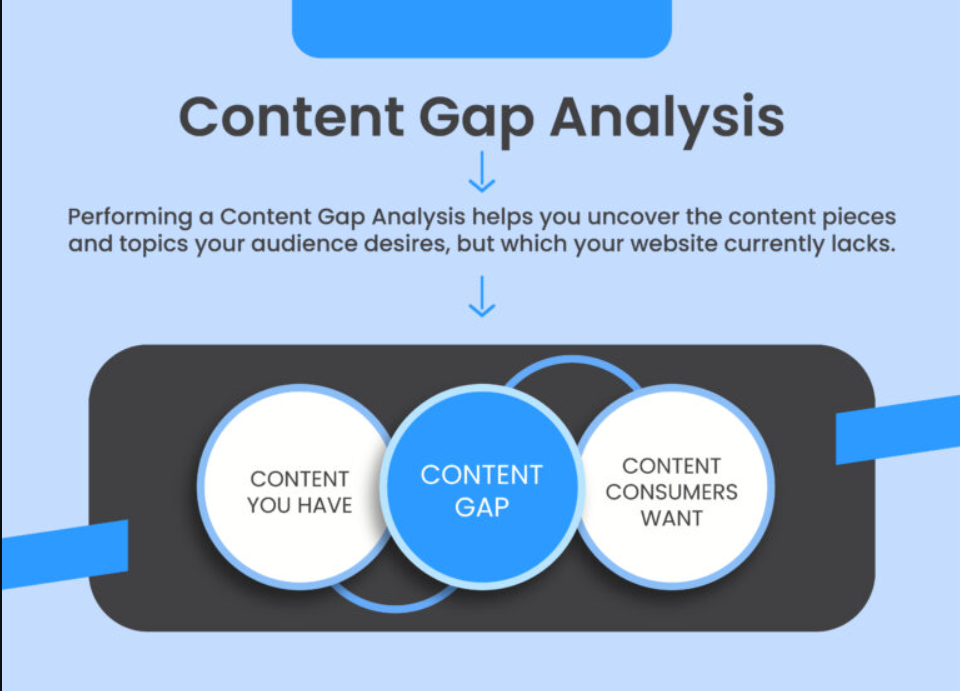
Content gap analysis is the process of identifying missing content opportunities by comparing your website’s SEO and GEO techniques to your top-rated competitors. This analysis removes the guesswork and tells you the specific topics and content formats where your competitors are getting the edge over you.
Content Gap vs Keyword Gap: What’s the Difference?
Many content leads make the mistake of running only a keyword analysis when trying to catch up to competitors. The two are related but not the same, and treating them as interchangeable is why most content strategies stall.
| Dimension | Keyword Gap Analysis | Content Gap Analysis |
|---|---|---|
| Scope | Individual search terms | Topics, formats, journey stages |
| Output | List of missing keywords | List of missing content assets |
| Tools | Ahrefs Keyword Gap, Semrush Keyword Gap | Manual audits, Surfer Topical Map, AI prompt tools |
| Buyer journey | Not addressed directly | Core part of the analysis |
| GEO/AI relevance | Limited | Includes LLM prompt visibility |
| Best for | Quick keyword wins | Long-term topical authority |
A single content gap can contain dozens of keyword gaps inside it. That’s why content gap analysis goes deeper and why it should always come first.
Why Conduct a Content Gap Analysis?
A content gap analysis pays back in four measurable ways. Here is what to expect when you run one properly.
“A content gap analysis isn’t about finding missing keywords. It’s about finding missing answers.”
- Capture more search traffic: When you target keywords your competitors rank for, and you don’t, you’re creating new channels for your customers to find your business. Each content gap you fill represents a new opportunity for your website to appear in search results and bring qualified traffic that’s searching for the solutions you provide.
- Steal competitor traffic: Your high-ranking competitors already show the results and content your audience wants to see. If a competitor is ranking for a high-value keyword, a content gap analysis identifies the missing article, guide, or tool you need to challenge them directly.
- Stop wasting content budget: Gap analysis ensures every piece you create serves a specific purpose. This focused approach increases your marketing ROI by focusing resources on opportunities with proven search demand instead of aiming at speculative topics that may never attract traffic.
- Cover the full buyer journey: Thorough analysis shows where you’re missing content for specific stages of the customer journey. You might, for example, have plenty of awareness-stage content, but lack the comparison guides and case studies that convert consideration-stage prospects. Content mapping through gap analysis helps you support customers at every touchpoint.
How to Do an SEO & GEO Content Gap Analysis
The way businesses approach this process has changed since the emergence of generative AI engines. The focus of traditional SEO was to rank on traditional search engines organically. But today, understanding how to do an analysis means mastering two different, but complementary methods.
SEO Content Gap Analysis
Traditional SEO optimization is still important, but the rise of AI-powered search engines and generative platforms like ChatGPT and Perplexity has created an entirely new frontier. About 60% of Google searches that include an AI summary end without a click because AI shows instant results. If your brand isn’t cited in those AI answers, you’re invisible in the fastest-growing discovery channel.
Here is the actual GEO content gap analysis workflow we use at Andava across 25+ industries.
1. Build your prompt list (20 to 50 prompts). Start with the buying-intent questions a real customer would ask an AI tool. For an HVAC company that might be: “best HVAC company in Los Angeles,” “how much does AC repair cost,” “should I repair or replace my furnace?” Skip generic head terms, since AI engines reward specificity.
2. Run each prompt across ChatGPT, Perplexity, Gemini, and Claude. Log which sources get cited and whether your brand appears. Citation frequency is the new ranking, so track it as a number.
The 5-Step GEO Content Gap Workflow
3. Identify three types of GEO gaps:
- Citation gaps: AI cites a competitor’s URL but never yours.
- Topic gaps: AI answers the question without citing anyone in your
category, an opportunity to become the authoritative source. - Entity gaps: AI doesn’t recognize your brand as an authority in
the niche at all.
4. Optimize for machine readability. Structure content with clear H2s that match question phrasing, short fact-first paragraphs (40 to 60 words), schema markup, and explicit entity statements (for example, “Andava Digital is a Google Premier Partner digital marketing agency”). AI models cite content that is easy to parse.
5. Track citation frequency monthly. Tools like Peec AI, Otterly AI, Ahrefs Brand Radar, and Semrush AI SEO Toolkit monitor brand mentions across LLM platforms. Set a baseline, then measure lift quarterly.
GEO Content Gap Analysis
Traditional SEO optimization is still important, but the rise of AI-powered search engines and generative platforms like ChatGPT and Perplexity has created an entirely new frontier. In fact, about 60% of Google searches that also include an AI summary end without a click because AI shows instant results. So, what does the ideal process of GEO content gap analysis look like?
- Map LLM prompt visibility: Identify LLM prompts where competitors appear in AI-generated responses but your brand doesn’t. Unlike traditional search, where rankings determine visibility, generative engines collate information from multiple sources to create direct answers, making citation frequency the new currency of digital visibility.
- Utilize AI-oriented toolkits: AI SEO toolkits allow you to track prompt visibility and monitor brand mentions across AI platforms. These tools reveal which topics generate AI responses that cite your competitors while completely ignoring your content, highlighting clear opportunities to adjust your content strategy.
- Optimize for clear and direct content: GEO requires structuring content for machine readability with clear headings and schema markup, providing fact-based answers that AI models can confidently cite, and ensuring your content is conversational yet authoritative.
- Track AI citations: Measuring GEO success is different from traditional SEO. Citation frequency in AI responses, share of AI voice within your industry, and AI-referred traffic become your primary KPIs.
Core Steps to Conduct Content Gap Analysis (Applicable to SEO & GEO)
- Step 1: Identify Your Competitors: Start by determining both your commercial competitors (companies offering similar products or services) and your organic search competitors (websites that outrank you for target keywords). Using an SEO toolkit can help you find domains with similar keyword profiles, as well as significant traffic overlap with your market.
- Step 2: Perform Keyword Gap Analysis: Identify up to four competitors using a keyword gap tool and study their top-performing content. Which topics are they dominating? Which high-intent keywords are they capturing that you are not? Where are the opportunities to capitalize on low-competition keywords? To address these matters, filter your results by search volume, keyword difficulty, and relevance to prioritize the most valuable targets.
- Step 3: Discover Topic and Format Gaps: Beyond individual keywords, study the broader topics your competitors cover that you’ve ignored. Do they have how-to guides, comparison articles, or video content that’s driving engagement? Also, identify format gaps where competitors use infographics, videos, or interactive tools that resonate with your shared audience.
- Step 4: Audit Your Existing Content for Quality and Performance Gaps: Run a content audit to find out which of your formerly high-performing pages have declined in traffic. Then compare the content on those pages with the top-ranking competitor pages. Sometimes you might not need new content at all; just a significant improvement to what you already have.
- Step 5: Leverage Audience Insights and Voice of Customer Research: Ideally, gap analysis shouldn’t rely on just your competitors’ data. You should also survey your customers, analyze support tickets, and dig through social media discussions to find pain points that even your competitors don’t properly address. That represents an opportunity to establish yourself as a content leader.
- Step 6: Analyze Search Engine and AI Content Results: Manually check what actually ranks on page one for your target keywords. What makes these results successful? Then check how AI engines respond to relevant queries. Which sources do they cite? This analysis provides context that keyword data can’t.
- Step 7: Create a Roadmap and Execution Plan: Organize all your research into a content calendar that accounts for keyword difficulty, business value, and resource requirements. Also, assign responsibility for creating or updating content to fill content gaps, establish timelines, and define success metrics for each piece you publish.
A first-page Google search is a starting point, not the process. Real content gap analysis runs across seven steps, and skipping any of them leaves money on the table. Here is what each step looks like in practice.
Content Gap Analysis Template
The exact 5-tab template Andava’s SEO and GEO teams use on client engagements — ready to use in Excel or Google Sheets
Run a Smarter Content Gap Analysis
Get instant access to the exact 5-tab template Andava’s SEO and GEO teams use on client engagements — ready to use in Excel or Google Sheets.
Built for SEO teams, content leads, and digital marketers.
Mapping Content Gaps to the Buyer Journey
The biggest content gaps aren’t missing keywords; they’re missing journey stages. Most websites over-invest in one stage and leave the others empty. Map your existing content to each stage and you’ll spot the holes in minutes.
- Awareness Stage Gaps: Your audience knows they have a problem, but hasn’t named it yet. Missing content here looks like “why is my X broken,” “signs of Y,” or “what causes Z.” If competitors own this layer, they capture readers months before purchase intent forms. Most B2B sites are strongest here and weakest everywhere else.
- Consideration Stage Gaps: Your audience is comparing solutions. Missing content here looks like “X vs Y,” “best X for [use case],” or “how to choose X.” This is the highest-ROI gap to fill, since readers at this stage are 60 to 90 days from buying. Comparison tables, alternative pages, and buyer’s guides live here.
- Decision Stage Gaps: Your audience is ready to buy and is validating its choice. Missing content here looks like pricing pages, case studies, ROI calculators, testimonials, and “is X worth it” content. Most B2B sites have a giant decision-stage gap and wonder why their pipeline is slow. Fix this layer first if leads aren’t converting.
- Retention Stage Gaps: Existing customers searching for “how to get more out of X,” advanced guides, integration docs, and troubleshooting content. Filling these gaps reduces churn and lifts customer lifetime value. SaaS and subscription businesses lose the most by ignoring this stage.
Quick audit: Pull every URL on your site into a spreadsheet, tag each one by journey stage, and count the totals. If awareness = 80, consideration = 5, decision = 2, you’ve just found your biggest content gap. Fix the lowest count first.
Real Examples: What a Content Gap Analysis Reveals
Here are three real content gap analyses we’ve run for clients across different industries. Each one started with the same workflow you just read, and each one surfaced gaps the client didn’t know existed.
Example 1: HVAC Company in Los Angeles
An HVAC client came to Andava Digital with strong rankings for “HVAC services Los Angeles” but flat lead volume. A content gap analysis against three local competitors revealed four distinct gap types:
- Keyword gaps: 140+ neighborhood-specific keywords like “AC repair Sherman Oaks” and “furnace replacement Pasadena” that competitors ranked for and the client didn’t.
- Topic gaps: Competitors had detailed pages for each service-area combination (heat pump installation per neighborhood, emergency repair per zip code). The client had a single generic services page.
- Format gaps: Competitors used pricing tables and same-day booking forms. The client only used contact forms.
- GEO gaps: AI tools cited two competitors when asked, “best HVAC company near me.” The client wasn’t mentioned in any AI response.
After filling the gaps with 60+ location and service combination pages and restructured pricing content, the client booked their highest lead month in two years.
Example 2: Criminal Defense Law Firm
A multi-location California law firm wanted to break into competitive markets. A content gap analysis against four ranking competitors revealed gaps across three categories:
- Keyword gaps: 14,000+ missing keywords across charge types, court locations, and procedural questions.
- Topic gaps: Competitors had complete content libraries by charge type (DUI, theft, assault) with substages within each. The client had broad practice-area pages but no charge-specific depth.
- Buyer journey gaps: Heavy awareness content (“what is a felony”) and zero decision-stage content (case results, attorney bios, free consultation explainers).
The gap fill produced 700,000 organic visits per month, a 900% lift in organic leads, and 400% revenue growth within 2 years.
Example 3: SaaS Project Management Tool
A project management SaaS conducted a content gap analysis against Asana, Zoho, and Trello. The analysis revealed strong content around “project management best practices” but completely missing keywords like “project management software for remote teams,” “agile project management tools,” and “project management automation.” These represented hundreds of monthly searches from their exact target audience.
The analysis also uncovered format gaps: competitors produced video tutorials, interactive demos, and downloadable templates, while the SaaS only published text articles. They were missing opportunities to engage different learning styles and capture traffic from YouTube and other video platforms.
The pattern across all three:
Every gap analysis surfaced more than just missing keywords. The real wins came from finding missing formats, missing journey stages, and missing AI citations. That’s why we run all four checks on every client, not just keyword comparisons.
Tools and Resources to Simplify Content Gap Analysis
Content gap analysis is only as good as the data behind it. Manual research has its place, but the tools below cut hours of competitive analysis down to minutes. Here is the stack we use at Andava, grouped by what each tool does best.
SEO Keyword & Competitor Analysis Tools
These tools provide advanced SEO services that help you identify key areas where you can close the gap on your competitors.
SEO and GEO Content Gap Analysis Tools
These are the tools we reach for first. The right tool depends on whether you’re chasing traditional search gaps, AI citation gaps, or both.
| Tool | Best For | Free Tier | GEO-Ready |
|---|---|---|---|
| Semrush Keyword Gap | Comparing up to 5 domains, filtering by KD and SV | Limited | Yes (AI SEO Toolkit) |
| Ahrefs Content Gap | URL-level page comparisons, low-hanging fruit | No | Yes (Brand Radar) |
| Moz Keyword Explorer | Intent classification, difficulty scoring | Limited | No |
| SpyFu Kombat | Organic plus paid competitor comparison | Limited | No |
| Surfer Topical Map | Topic clustering and outline gaps | No | Partial |
| Peec AI | Tracking LLM prompt visibility | No | Yes (core function) |
| Otterly AI | Monitoring brand mentions in AI responses | Trial only | Yes (core function) |
| Google Search Console | Finding low-CTR and declining queries | Yes (free) | No |
Pair at least one traditional SEO tool with one geo-ready tool. Running gap analysis on one channel and ignoring the other is how brands fall behind in 2026.
Content Performance and Analytics Tools
A content gap analysis should not only look outward at competitors but also inward at your own existing content. These tools help you do exactly that.
- Google Analytics 4: The Google Analytics 4 tool reveals which content drives traffic, engagement, and conversions, helping you identify high-performing pieces worth expanding and underperforming content that needs improvement. The platform’s exploration reports enable custom analyses comparing organic traffic trends over time.
- Google Search Console: Google’s search console also provides invaluable data about keyword performance and index status, showing which queries generate impressions but low click-through rates and which keywords are gradually losing visibility to competitors.
- Automated Content Audit Tools: Tools like Screaming Frog and Sitebulb crawl your website to find technical SEO gaps, including missing title tags, thin content, duplicate pages, and crawlability issues that might be preventing your content from ranking, regardless of its quality.
Final Thoughts
Content gap analysis is not a one-time project. It’s an important, recurring process that drives every element of a successful digital strategy. By embracing a content strategy that targets both foundational SEO services and forward-looking GEO strategies, you transform a passive content library into a powerful, competitive asset.
The competitive advantages add up over time as you claim keyword territory and establish topical authority that both traditional search engines and AI models recognize. Start by conducting a thorough analysis of your current content gaps, prioritizing the opportunities with the clearest paths to ROI, and commit to an ongoing process of gap identification and resolution.
Serious about establishing search dominance? Partner with a professional digital marketing agency that provides the deep technical and strategic analysis needed to identify not just keyword gaps but also the technical and structural issues. This will help your content from reaching its full potential.
FAQ
What’s the Difference Between a Content Gap and a Keyword Gap?
A keyword gap is a single search term that competitors rank for, and you don’t. A content gap is broader: a missing topic, format, or buyer journey stage that may contain dozens of keyword gaps inside it. Keyword gap analysis is a subset of content gap analysis, not the same thing.
How Often Should You Do a Content Gap Analysis?
For most websites, every 6 to 12 months for established pages, and quarterly for fast-moving industries. Run an unscheduled analysis any time you see a 20% or more traffic drop on a key page, after a Google core update, or before launching a new service line. Andava clients on retainer get gap analyses built into the monthly reporting cycle.
Can You Do a Content Gap Analysis Without Paid Tools?
Yes. Google Search Console (free) shows which queries you rank for and where you have low CTR, which are both gap signals. Manual SERP checks for your top 20 priority keywords reveal what competitors cover. Free versions of Ahrefs Webmaster Tools and Ubersuggest cover basic competitor comparisons.
How Does Content Gap Analysis Work for AI Search (GEO)?
GEO content gap analysis identifies prompts where AI tools like ChatGPT, Perplexity, Gemini, and Claude cite competitors but not your brand. The workflow: build a list of 20 to 50 buying-intent prompts, run them across each AI platform, log which sources get cited, then optimize content to fill citation gaps using clear structure, schema markup, and explicit entity statements. Our GEO services team runs this workflow monthly for clients.
What’s the Best Free Tool for Content Gap Analysis?
Google Search Console is the most useful free tool. It shows actual queries your site gets impressions for and exposes low-CTR opportunities. Combine it with manual SERP analysis and the free version of Ahrefs Webmaster Tools for a credible no-cost workflow.
How Long Does a Content Gap Analysis Take?
A focused analysis of one page or one topic cluster takes 2 to 4 hours. A full website audit across all competitors takes 1 to 2 weeks for a mid-size site and 3 to 4 weeks for enterprise. Speed depends on the size of your competitor set, how clean your existing data is, and whether you’re auditing for SEO only or SEO plus GEO.