Australia’s digital advertising market reached AUD $18.4 billion in 2025, reflecting another year of double-digit growth as businesses continued shifting budgets from traditional media to online channels.
With internet penetration at 97.1% and social media reaching nearly 78% of the population, Australia operates as one of the world’s most mature digital marketing environments. Meanwhile, SEO, paid search, and social advertising remain the primary acquisition channels for Australian businesses.
This report compiles 100+ statistics that define the landscape of digital marketing in Australia in 2026.
Overall Market Size & Ad Spend
- Australia spent $16.4 billion on digital ads in 2024, an 11.1% year-on-year increase.
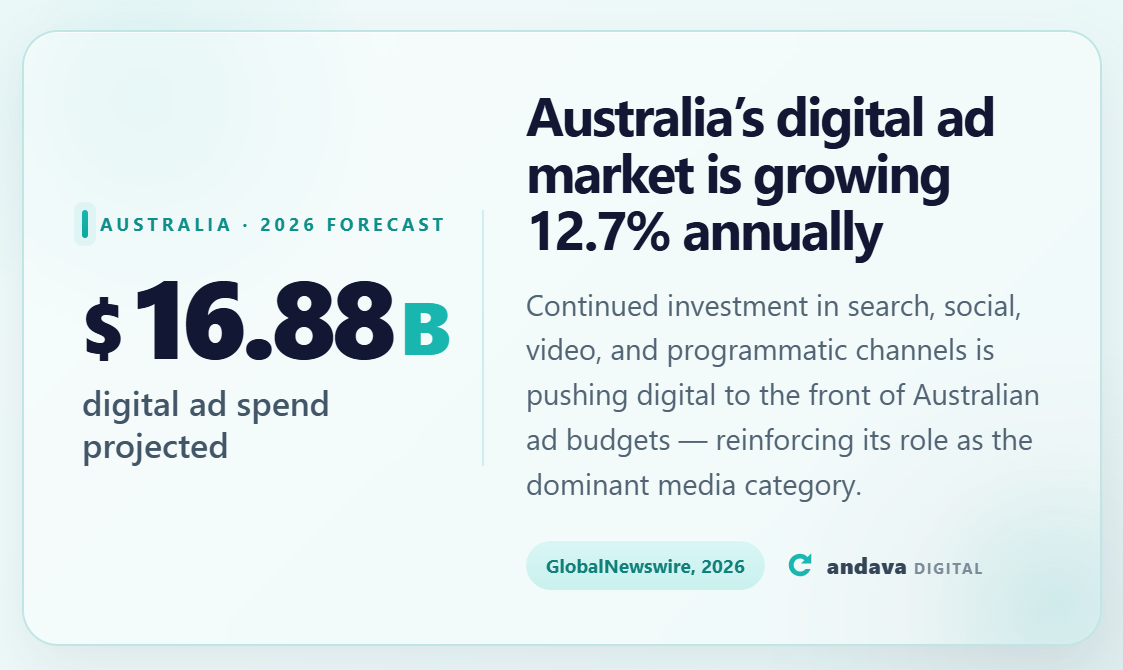
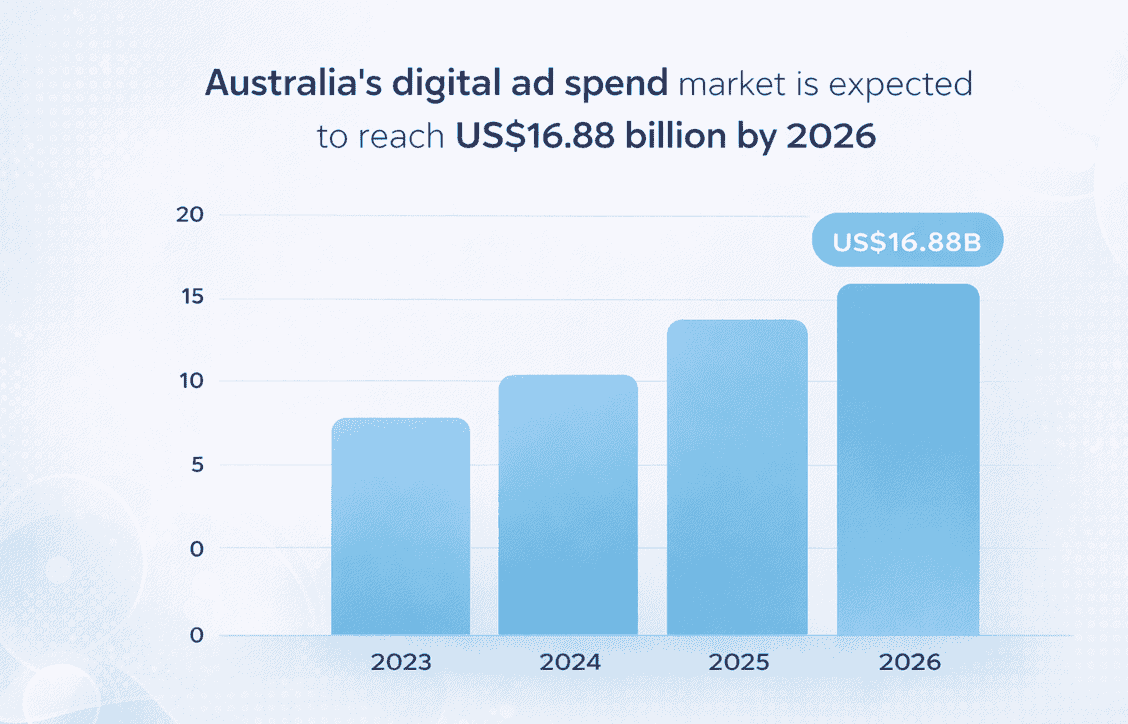
- Australia’s digital ad spend market is expected to grow by 12.7% annually, reaching $16.88 billion by 2026.
- Australia’s digital ad spend market achieved a CAGR of 10.7% between 2020 and 2025.
- The Australian digital marketing sector attained a value of $13.93 billion in 2025 and is projected to expand at a CAGR of 6.90% through 2035.
- Australia’s digital advertising landscape accounts for AUD $8 in every AUD $10 of total ad spend, with digital formats commanding a dominant share of overall budgets.
- Digital ad spend reached AUD $15.6 billion in the latest annual reporting period, representing a 9.7% increase year-on-year.
- The internet advertising market hit $4.2 billion for the March 2025 quarter alone, reflecting an 11.6% year-on-year increase.
- Australia’s digital marketing software market stands at $1.95 billion in 2025 and is projected to climb to $3.21 billion by 2030 at a 10.48% CAGR.
- Small and medium enterprises commanded 58.20% of Australia’s digital marketing software market in 2024 and are advancing at a 13.90% CAGR to 2030.
- New South Wales leads regional digital marketing investment, accounting for 33.8% of total revenue share in 2025, with a forecast CAGR of 7.4% over the forecast period.
Digital Advertising Spend by Channel
- In Q1 2025, search revenue rose by 10% to $1.896 billion.
- Search is still the most popular way to advertise on the internet in Australia, accounting for 44% of all online ad spending.
- Video advertising represents approximately 29% of all internet ad spend in FY2025, making it the second-largest and fastest-growing category.
- Social media advertising spend increased 12% year-on-year to $4.26 billion, now accounting for 29% of total digital ad spend.
- Connected TV (CTV) advertising accounts for 55% of video inventory in Australia.
- The real estate industry drove a 7.8% rise in classified listings, which reached $660 million in the March 2025 quarter.
- Digital retail media spend grew 23% in 2024, reflecting the rapid expansion of retailer-owned advertising platforms such as Woolworths’ Cartology and Coles 360.
- Between 2025 and 2030, marketing automation had the highest growth rate of any software category, with a CAGR of 14.80%.
- Email marketing retained the largest revenue share among digital marketing software categories at 28.30% in 2024.
- Cloud platforms captured 66.50% of Australia’s digital marketing software market share in 2024 and are growing at a 12.40% CAGR through 2030.
Search & SEO Performance
- Google has a combined search engine market share of 94.1% in Australia, with 93.2% on desktop and 94.8% on mobile.
- Google accounts for 93% of all search engine usage in Australia.
- Bing holds approximately 4% of Australia’s search engine market.
- Mobile search queries account for 67% of total search volume in Australia.
- Zero-click searches account for approximately 58% of all searches in Australia, up from 51% in 2023, as Google’s AI Overviews and featured snippets reduce organic click-through rates.
- Australian businesses are expected to spend $1.5 billion on SEO services in 2025, up 12% from 2024.
- Small businesses in Australia allocate an average of $1,200 per month to SEO.
- 63% of Australian SMEs favor online search advertising.
- Long-tail keywords account for 70% of all searches in Australia.
- The e-commerce sector accounts for 35% of total SEO spending in Australia.
Local SEO & Google Business Profile Statistics
- 46% of all Google searches in Australia have local intent, emphasising the need for local SEO.
- 56% of local businesses in Australia have not yet claimed their Google Business Profile listing.
- 70% of Australians will go to a store because they found information online.
- A purchase happens after 28% of local searches in Australia.
- 33% of Australians use voice search daily, primarily for local queries.
- Voice search queries in Australia are typically 6–10 words long, reflecting conversational search behaviour.
- Businesses that optimise for local keywords experience a 27% increase in leads.
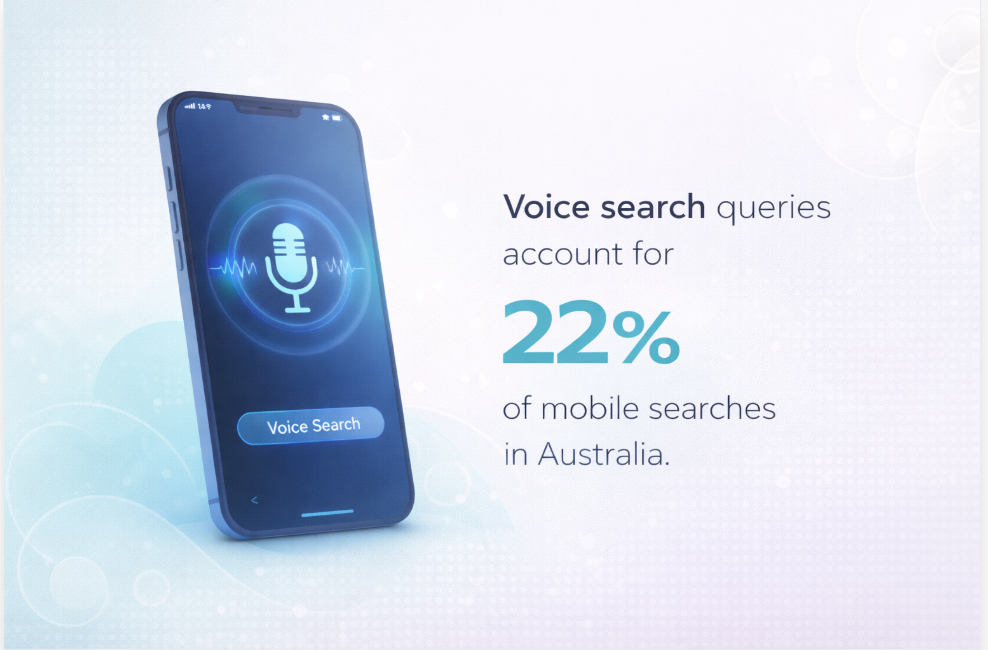
- Voice search queries account for 22% of mobile searches in Australia.
- Smart speaker ownership has reached 31% of Australian households.
- Voice search queries are used by 23% of Australians regularly, primarily for local and informational queries rather than transactions.
PPC & Paid Search Performance
- For Australian advertisers, Google Ads is still the #1 paid search platform.
- 65% of Australian SMEs use paid search advertising such as Google Ads.
- Search advertising alone costs Australian businesses about AUD $6.9 billion a year.
- Page one organic results have an average click-through rate of 27.6%.
- The BFSI sector is expected to be the fastest-growing end-use vertical for digital marketing software, with a CAGR of 8.1% during the forecast period.
- 12.7% annual growth is expected in Australia’s digital advertising market as brands shift toward integrated, privacy-first marketing strategies.
- Paid social media traffic to Australian sites converts at 9.21%, which is much better than organic channels.
- LinkedIn delivers 113% ROAS for Australian B2B, outperforming Google Search (78%) and Meta Ads (29%) in recent performance studies.
- TikTok achieves 0.84% CTR at just $1.00 CPC (42% cheaper than Facebook).
- The average monthly spend on Google Ads in Australia ranges from AUD $5,000 to $20,000, with annual digital marketing budgets falling between $30,000 and $144,000.
Social Media Usage & Advertising
- 21 million Australians use social media, representing 77.7% of the total population.
- There were 20.9 million active social media user identities in Australia in January 2025, equating to 77.9% of the total population.
- Australians use an average of 6.5 different social media platforms each month.
- 78% of Australians who use social media still use Facebook, making it the most popular platform.
- Instagram is used by 65% of Australian social media users and is Australia’s preferred social app (22%), followed by Facebook (20%) and TikTok (14%).
- TikTok leads Australian Android users in time spent, with an average of 38 hours and 51 minutes per month, surpassing the global average of 34 hours and 56 minutes.
- More than 58% of Australians now turn to social media for brand and product research, rivalling traditional search engines at 62%.
- 81% of Australian SMBs now maintain at least one active social media presence.
- 67% of Australians who use social media have bought something directly through social media in the last year, which is a 38% increase from previous years.
- Australians now spend an average of 23.4 minutes per session on TikTok, highlighting the platform’s growing digital marketing potential.
Consumer Digital Behaviour Statistics
- Australians spend an average of 6 hours and 8 minutes per day online.
- Australians spend an average of 1 hour and 51 minutes per day on social media.
- Australia had 34.4 million cellular mobile connections at the start of 2025, equivalent to 128% of the total population.
- Mobile internet access is used by 97.6% of Australians aged 16+.
- 91% of adults in Australia shop online regularly, and each person makes an average of 2.9 purchases online each month.
- 73% of online purchases in Australia are made on mobile devices.
- Social media is the most common news discovery channel for Australians, used by 48% of the population, ahead of news websites and apps at 42%.
- 75% of Australians worry about fake online info, with Australia in the top five countries for misinformation and data privacy concerns.
- 43% of Australians are concerned about how companies handle their data.
- 47% of Australian internet users are regular gamers, with mobile gaming accounting for 68% of gaming activity.
| Search Engine | Desktop Share | Mobile Share | Combined Share |
|---|---|---|---|
| 93.2% | 94.8% | 94.1% | |
| Bing | 4.8% | 3.1% | 3.8% |
| DuckDuckGo | 1.1% | 0.9% | 1.0% |
| Yahoo | 0.6% | 0.7% | 0.7% |
| Other | 0.3% | 0.5% | 0.4% |
Content Marketing Trends
- 74% of Australian businesses have a documented content marketing strategy.
- Video content accounts for 64% of all digital content consumed by Australians, with 89% of marketers reporting video as their highest-performing content type.
- 62% of Australian marketers consider blogs and articles their most effective content type.
- Businesses with a documented content strategy see 3x higher ROI compared to those without one.
- Long-form content of 1,500+ words generates 2x more traffic than short articles in the Australian market.
- Interactive content, such as quizzes, calculators, and polls, sees a 30% higher engagement rate compared to static formats among Australian audiences.
- 56% of Australian businesses use AI-driven content optimisation tools.
- 35% of Australian marketers now use AI to generate written or visual content.
- Sustainability-related content sees a 22% higher engagement rate in Australia, reflecting consumer interest in ethical business practices.
- Australians spend an average of 3 hours per day consuming digital content.
Email & Direct Response ROI
- It’s anticipated that SMEs can expect an average ROI of $40 returned for every $1 spent on email marketing by 2027.
- 86% of Australian businesses use email marketing to communicate with their customers.
- Facebook Messenger is used regularly by 67% of Australians, making messaging platforms an increasingly important customer service channel.
- 42% of Australians use WhatsApp on a regular basis, with people expecting to get replies on messaging apps much faster than on email.
- Personalized, triggered emails based on behaviour perform 3x better than batch-and-blast campaigns in the Australian market.
- Regionally, Australian email campaigns achieved 46.34% open rates, leading other markets like LATAM.
- Australian SMEs can realistically expect email marketing ROI between 3:1 and 5:1 ($3-$5 returned per $1 spent) when focusing on established strategies like nurturing.
- 75% of email opens in Australia occurred on mobile devices, highlighting the need for a responsive design.
- Email click-through rates in Australia stood at 3.5% in 2026, outperforming global benchmarks due to compelling, localized content.
- In Australia, the average response rate for direct mail to house lists is 5.3%, while the average response rate for direct mail to prospect lists is 2.9%.
Ecommerce & Digital Revenue Contribution
- Buy-now-pay-later (BNPL) options embedded in checkout flows generated AUD $16 billion in transaction volume in Australia.
- 9.8 million Australian households shopped online, and half of Gen Z and millennial shoppers made purchases through apps every week.
- Digital wallet payments are preferred by 23% of Australian online shoppers, followed by cards at 61% and BNPL at 11%.
- Retail and e-commerce remained the dominant digital marketing software spending vertical in 2024 at 24.50% of total industry revenue.
- Healthcare is the fastest-growing vertical for digital marketing software adoption in Australia, projected to grow at a 15.40% CAGR through 2030, driven by telehealth investment.
- Australia’s e-commerce market reached AUD $33.83 billion in 2025, projected to grow to AUD $56.70 billion by 2035 at a CAGR of 5.30%.
- B2C e-commerce in Australia hit $51.57 billion in 2024.
- Australian SMBs adopting online retail channels generate 2.2 times more revenue and are 45% more productive than offline peers.
- E-commerce penetration is expected to rise from 65.3% in 2024 to 84.4% by 2029, enhancing digital revenue share across sectors.
- B2C e-commerce in Australia is forecast to reach $70.70 billion by 2029, with a 6.3% CAGR from 2025 to 2029.
Conversion Rate & Landing Page Benchmarks
- Arts & crafts e-commerce sites in Australia achieve conversion rates of 5.2%.
- 28% of local search queries on Google in Australia lead directly to a finalized purchase or booking.
- Food & beverage e-commerce sites in Australia achieve the highest conversion rates at 6.26%.
- Luxury brands in Australia see e-commerce conversion rates around 1.46%, while home & furniture averages 4.94%.
- Average landing page conversion rates across industries range from 2.35-4.14%, with top 10% performers exceeding 11.45%.
- A/B testing improves average conversion rates by nearly 50% and headline selection conversions by 10% in Australian campaigns.
- Only 17% of marketers use A/B testing to improve landing pages.
- Shopify stores in Australia average 1.4% conversion.
- Cart abandonment rates in Australia hit 62.6%, with checkouts over 90 seconds causing 47% conversion drops.
- Mobile in Australia converts at 1.8% on average despite relatively high traffic.
Website Performance & Page Speed Statistics
- Median mobile internet download speed in Australia is 103.46 Mbps as of early 2025, increasing 10.2% year-on-year.
- As of early 2025, the median fixed internet download speed in Australia is 77.90 Mbps, which is 43.2% faster than the previous year.
- 5G mobile coverage now reaches 85% of the Australian population.
- A 1-second delay in page load can reduce conversions by up to 20% for Australian ecommerce sites.
- Australian mobile traffic crossed 50% for the first time in 2025.
- The number of mobile connections in Australia increased by 674,000 (+2%) between 2024 and 2025, showing increased potential for mobile marketing.
- Video content accounts for approximately 73% of internet traffic in Australia.
- Small business sites in Australia can reduce load times by 30-50% through basic optimizations like image compression and caching.
- Mobile bounce rates in Australia average 51-54.3%, 12% higher than desktop’s 42.8-43%, due to slower load experiences.
- E-commerce sites maintain bounce rates of 20-45% in 2026 benchmarks, with speed directly influencing early exits.
Mobile, Local & Emerging Channels
- Australia has 34.1 million mobile connections, exceeding the population.
- Mobile accounts for over 51% of total online time in Australia.
- Social media is accessed via mobile devices by approximately 92% of Australian users.
- Australians aged 16–24 spend an average of 7 hours and 18 minutes online each day, with 89% using mobile as their primary device.
- Mobile voice search is used by 29% of Australians regularly.
- Mobile gaming is played by 68% of Australian gamers, reflecting the dominance of smartphones across entertainment categories.
- Australians are among the top-five countries globally for time spent on Snapchat’s Android app, averaging 16 hours and 26 minutes per month across 490 sessions.
- Australia ranks among the top five countries globally for time spent on LinkedIn’s Android app, at 1 hour and 6 minutes per month across 42 sessions.
- 78% of mobile local searches in Australia lead to purchases within 24 hours.
- Restaurants and cafes account for 32% of local searches in Australia, followed by retail at 21% and professional services at 18%.
Video Advertising & OTT Trends
- Video ad spending in Australia increased 18.6% to AUD $4.1 billion, driven by CTV adoption and BVOD platform growth.
- YouTube is used by 92% of Australian internet users, with average daily usage of 47 minutes per person.
- Video advertising now accounts for 29% Australian digital advertising expenditure.
- Social video accounts for 40% of all video investment in 2025, growing 35% year-on-year.
- 72% of Australian social media users watch short-form videos daily, making video-first content a non-negotiable component of social strategy.
- YouTube delivers 68% of Australian users who reported purchasing a product after seeing it featured on the platform.
- 5.6 million Australian households subscribe to at least one paid ad-supported (AVoD) streaming service, up 77% year-over-year in Q3 2025.
- 30% of new streaming subscribers in Australia chose ad-supported plans in Q3 2025, with Netflix leading at 73% among its new users.
- Short-form video content delivers 2.5x more engagement than long-form across Australian social platforms, with optimal lengths of 15-60 seconds.
- 61% of Australian consumers are more likely to purchase after viewing product demo Reels, with 74% messaging businesses directly.
Influencer Marketing Growth
- Influencer marketing investment in Australia reached $520 million in 2025, a 13% year-on-year increase.
- Australia has seen a 43% increase in professional content creators over the past two years, expanding the creator economy and influencer marketing opportunities.
- Instagram is the #1 platform for influencer campaigns in Australia, while TikTok is the fastest-growing.
- 58% of Australians adjusted their social media privacy settings in the past year, creating challenges for influencer and paid social campaigns dependent on precise targeting.
- Influencer marketing in Australia is predicted to increase by 11% each year starting in 2025.
- 25% of Australians aged 18-44 identify as influencers.
- 46% of Australians say they buy things because of endorsements from influencers they follow on social media rather than from traditional celebrities.
- Influencer marketing in Australia is projected to surpass AUD $1.26 billion by 2028.
- Ad spending in Australian influencer advertising was forecasted to hit an average of AU$35 per internet user in 2025.
- 55% of Australian adults aged between 18 and 60 say they’d be willing to give up their careers to become an influencer.
B2B Digital Marketing Statistics (Australia)
- LinkedIn’s ads reached 17 million users in Australia, up 13% from the previous year. This is more than 80% of Australians aged 18 and older.
- B2B content on Australian LinkedIn accounts generates 3.5x higher engagement rates than global B2B content averages.
- LinkedIn video content receives 82% higher share rates than text-only posts in the Australian market.
- 65% of LinkedIn users in Australia are in managerial positions or above, making it a premium channel for B2B decision-maker targeting.
- 64% of B2B content marketers in Australia use SEM or PPC to distribute content.
- Australian companies with documented B2B content strategies achieve 3.2x higher ROI, with 74% maintaining formal plans in 2025.
- Video content ranks as the most effective B2B format for 67% of Australian marketers, boosting organic traffic by 157%.
- Sustainability-focused B2B content generates 22% higher engagement among Australian decision-makers.
- 56% of Australian B2B businesses adopted AI-generated content in 2025, enhancing personalization, while interactive formats lift engagement 35%.
- Email marketing delivers $44 ROI per $1 spent for Australian B2B, outperforming other channels for lead nurturing.
Marketing Technology & AI Adoption
- 12.7 million Australians, or 57% of the population aged 14+, used an AI tool in April 2025, a 109% year-on-year increase.
- 49% of Australians say they have used generative AI in 2025, up from 38% in 2023.
- 92% of Australian marketers say AI has impacted their role, with over a third describing the change as very significant.
- 30% of Australian marketers use AI for data analysis and insights.
- 20% of Australian marketers rely on AI to support workflow automation.
- 78% of Australian go-to-market teams used generative AI features to reduce lead-nurture setup from two weeks to two days.
- 60% of Australian marketers are not proficient in AI tools.
- The Australian digital marketing software market is expected to require 156,000 additional technology workers by 2027.
- AI-driven martech solutions fuel 19.2% CAGR growth in Australia’s digital marketing software sector through 2033, reaching $7.5 billion.
- From 2024 to 2025, the number of Australians who used and adopted AI tools grew by 27.3%.
AI Search & Generative Search Trends
- ChatGPT awareness stands at 76% among Australians, with 31% reporting monthly usage.
- 64% of Australians say they’ve seen Google’s AI Overviews, which are already making people less likely to click on organic results.
- Perplexity AI usage has reached 7% of the Australian internet population.
- 74% of Australians apply generative AI tools in workplace settings.
- 48% of Australians have used AI assistants for online product searches, rising to 66% among those under 45 years old.
- 78% of Australians expect AI shopping tools to become mainstream in online retail experiences within the next year.
- 61% of Australians trust AI-generated product recommendations, with 18% placing full confidence in AI-led suggestions.
- 53% of Australians plan to use AI shopping tools in the coming year, while 30% require trusted brands for engagement.
- Traditional search engine volume in Australia will drop 25% by the end of 2026 due to AI chatbots and virtual agents.
- Nearly 50% of Australians now demonstrate a good understanding of generative AI search, paralleling sustained adoption growth.
Data Privacy, Cookies & First-Party Data
- 74% of Australians are concerned about data privacy, yet convenience consistently outweighs privacy concerns in platform selection.
- 38% of Australian internet users use ad blockers.
- 31% of Australians clear cookies regularly, further complicating audience measurement and attribution.
- Only 18% of Australians actually read privacy policies before accepting them, reflecting widespread consent fatigue.
- AUD $50 million or 30% of annual turnover is the maximum penalty for serious breaches of Australia’s Privacy Act.
- New Privacy Act obligations require automated decision-making (ADM) transparency in policies by December, 2026, with civil penalties up to AUD $50 million.
- 92% of Australian advertising decision-makers think that using data is very important for business success, and 80% think that first-party data is very important for targeting.
- 61% of Australian digital advertisers mark first-party data as critical for creative decisions, up significantly as transaction data importance surges.
- 89% of Australian digital advertisers express confidence in contextual targeting capabilities, a major improvement reflecting privacy-first adaptation.
- Transaction data was #1 for year-over-year importance increase for Australian advertisers, while demographics and prior ad exposure declined.
Digital Marketing ROI & Performance Benchmarks
- Buy-now-pay-later options increased conversion rates by 30% compared to credit-card-only checkout flows in Australia.
- Kmart Australia’s use of real-time triggered messaging achieved a 20-fold increase in customer response rates.
- Australian e-commerce sites average 1.78% conversion rates as of late 2024.
- B2B lead generation landing pages in Australia convert at 8.8-18.2%, while general B2B sites average 2-5%.
- Facebook traffic to Australian sites achieves 9.21% conversion rates across industries, outperforming other social sources.
- Desktop conversions in Australia average 3.2%, almost double mobile conversions despite mobile’s traffic dominance.
- Professional digital agencies deliver 38-214% lead increases, 26-71% revenue growth, and 2-5 times ROAS improvements for Australian clients.
- Email marketing delivers the highest ROI among all content formats in Australia, ranging from $42-44 for every $1 spent, depending on the industry.
- The top 10% best converting ecommerce platforms hit 4.7%+ through optimization.
- B2B services convert at 10-20%, SaaS at 7-15%, and retail at 3-8% in Australian benchmarks.
Business Priorities & Challenges
- Measuring ROI from digital marketing spend is cited as the top challenge for 47% of Australian marketers.
- 38% of businesses in Australia have trouble keeping up with changes to Google’s algorithms.
- 52% of Australians struggle to interpret predictive analytics, creating a growing skills gap.
- Graduation rates of young Australians proficient in digital marketing technology currently lag by 40%.
- 87% of regional Australian businesses report difficulty attracting martech specialists.
- Budget compression in traditional retail was identified as the #1 hindrance for digital marketing software growth in 2025, concentrated in brick-and-mortar retail chains.
- Fragmented state-level data privacy regulations cause scheduling delays for 38% of digital campaigns in Australia.
- 56% of Australian industry leaders cite AI and automation as a top operational challenge, with concerns over transparency, brand safety, and over-reliance on algorithmic systems.
- Strict data privacy regulations under the Australian Privacy Act impact 65% of digital campaigns, complicating tracking and personalized targeting.
- Adapting to constant algorithm changes from Google and social platforms affects 72% of Australian marketers, disrupting organic reach and SEO rankings.
Future Projections
- Australia’s digital ad market is projected to reach $25.38 billion by 2029, up from $14.98 billion in 2025.
- Australia’s digital advertising market is expected to grow at a CAGR of 14.6% from 2026 to 2029.
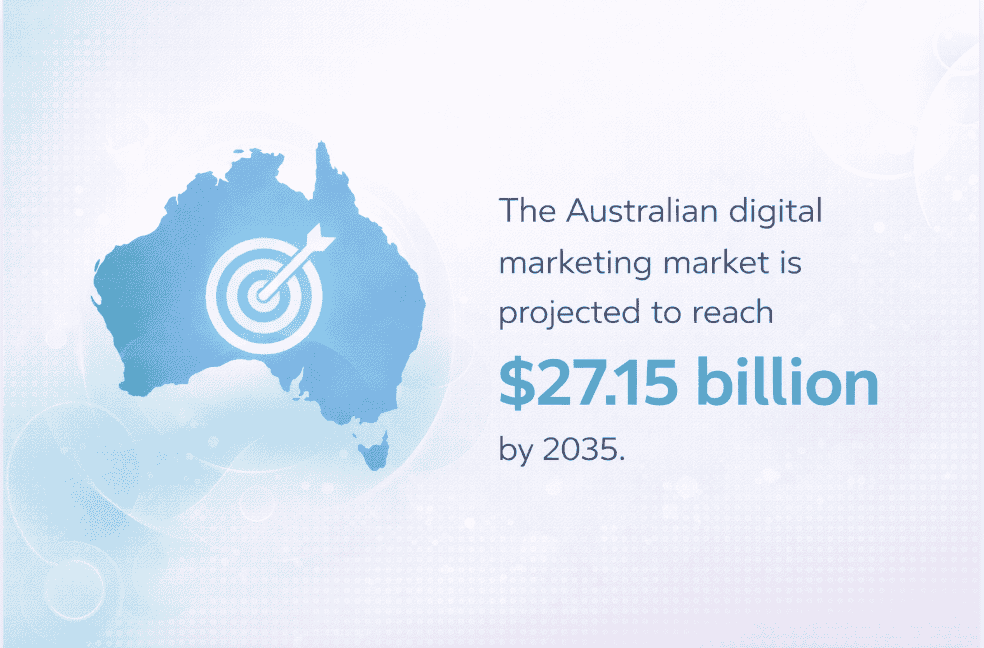
- The Australian digital marketing market is projected to reach $27.15 billion by 2035.
- The digital advertising market in Australia is expected to reach $35.75 billion by 2030, growing at a CAGR of 18.4%.
- Australia’s digital marketing software market is projected to reach $3.21 billion by 2030, growing at a 10.48% CAGR.
- Marketing automation adoption is forecast to accelerate, with the Australian market growing at a 14.80% CAGR through 2030.
- Digital ad spend tied to e-commerce will hit $17.2 billion in FY25, with retail media networks driving sustained double-digit annual growth.
- Voice and visual search will comprise 70% of all queries by 2030.
- 80% of Australian e-commerce organizations will use AI by 2026, with 33% fully implemented and 47% experimenting, positioning retail for mass adoption.
- Programmatic advertising spend is expected to grow at a CAGR of 11-14% between 2023 and 2030.
Australia’s digital landscape has reached a mature stage, with internet penetration stable above 97% and digital ad spend projected to surpass $25 billion by 2029. At the same time, AI is rapidly becoming a default layer across search, content creation, and campaign execution, with 49% of Australians already using generative AI tools in 2025.
These trends are directly shaping the evolution of digital marketing services in Australia, where businesses are shifting toward more data-driven, AI-supported strategies to remain competitive. As a result, these benchmarks now serve as a critical reference point for strategic planning, investment decisions, and channel prioritisation as Australia’s digital economy continues to evolve through 2026 and beyond.
References
- Atomic Digital Marketing. (2025). Australia’s Digital Marketing Industry Major Challenges. Retrieved from https://atomicdigitalmarketing.com.au/australias-digital-marketing-industry-major-challenges/
- Australia Post. (2025). Ecommerce Report. Retrieved from https://auspost.com.au/business/ecommerce/ecommerce-report
- Backlinko. (2025). Google CTR Stats. Retrieved from https://backlinko.com/google-ctr-stats
- CausalFunnel. (2025). Average Bounce Rate By Industry 2025 Benchmarks. Retrieved from https://www.causalfunnel.com/blog/average-bounce-rate-by-industry-2025-benchmarks/
- Conquerra Digital. (2026). Key Australian Marketing Stats: Ad Spend, Mobile Usage, and Online Behaviour in 2026. Retrieved from https://conquerradigital.com.au/key-australian-marketing-stats-ad-spend-mobile-usage-and-online-behaviour-in-2026/
- Cosmos Web Tech. (2025). Website Speed Optimization Small Business Guide 2025. Retrieved from https://www.cosmoswebtech.com.au/blog/website-speed-optimization-small-business-guide-2025/
- DataReportal. (2025). Digital 2025: Australia. Retrieved from https://datareportal.com/reports/digital-2025-australia
- Digimarcon. (2025). What Is The Future Of Digital Marketing In 2030. Retrieved from https://digimarcon.com/what-is-the-future-of-digital-marketing-in-2030/
- Dot To Dot Digital. (2025). Should I Be A/B Testing. Retrieved from https://www.dottodotdigital.com.au/should-i-be-a-b-testing/
- Ecommerce News Australia. (2025). Nearly Half Of Australians Use AI Assistants For Online Shopping. Retrieved from https://ecommercenews.com.au/story/nearly-half-of-australians-use-ai-assistants-for-online-shopping
- Envoy Social Solutions. (2025). The Rise Of Influencer Marketing In Australia A 2025 Projection Of Growth And Trust. Retrieved from https://blog.envoysocialsolutions.com/2025/03/27/the-rise-of-influencer-marketing-in-australia-a-2025-projection-of-growth-and-trust/
- Expert Market Research. (2025). Australia Digital Marketing Market Size, Share and Outlook. Retrieved from https://www.expertmarketresearch.com/reports/australia-digital-marketing-market
- Expert Market Research. (2025). Australia E-Commerce Market. Retrieved from https://www.expertmarketresearch.com.au/reports/australia-e-commerce-market
- Fifth Quadrant. (2026). 5 Powerful Generative AI Search Shifts. Retrieved from https://www.fifthquadrant.com.au/5-powerful-generative-ai-search-shifts
- GlobeNewswire. (2026). Australia B2C Ecommerce Market Forecast Report 2025–2029 Woolworths And Coles Anchor Omnichannel Ecosystems While Amazon And Temu Expand Scale And Local Seller Integration. Retrieved from https://www.globenewswire.com/fr/news-release/2026/01/29/3228358/28124/en/Australia-B2C-Ecommerce-Market-Forecast-report-2025-2029-Woolworths-and-Coles-Anchor-Omnichannel-Ecosystems-While-Amazon-and-Temu-Expand-Scale-and-Local-Seller-Integration.html
- GlobeNewswire. (2026). Australia Digital Ad Spend Business Report 2026. Retrieved from https://www.globenewswire.com/news-release/2026/02/10/3235209/0/en/Australia-Digital-Ad-Spend-Business-Report-2026
- Google. (2025). AI search adoption data for Australia. Retrieved from https://blog.google/intl/en-au/company-news/ai-adoption-in-australia-new-survey-reveals-increased-use-belief-in-potential/
- Grand View Research. (2026). Australia Digital Advertising Market Size & Outlook, 2030. Retrieved from https://www.grandviewresearch.com/horizon/outlook/digital-advertising-market/australia
- Grand View Research. (2026). Digital Marketing Software Market Australia. Retrieved from https://www.grandviewresearch.com/horizon/outlook/digital-marketing-software-market/australia
- Growth-onomics. (2025). Email Marketing Benchmarks 2026: Open Rates, CTRs. Retrieved from https://growth-onomics.com/email-marketing-benchmarks-2026-open-rates-ctrs/
- Hashmeta. (2025). Social Media Landscape in Australia: Key Stats, Trends & Top Platforms. Retrieved from https://hashmeta.com/blog/social-media-landscape-in-australia-key-stats-trends-top-platforms/
- Honen. (2025). Decoding Website Conversion Rates In Australia. Retrieved from https://honen.au/post/decoding-website-conversion-rates-in-australia
- HubSpot. (2025). State of Marketing Report. Retrieved from https://hubspot.com/state-of-marketing
- IAB Australia. (2025). Internet Advertising Revenue Report. Retrieved from https://iabaustralia.com.au/resource/internet-advertising-revenue-report
- IAB Australia. (2026). Internet Advertising Revenue Report Dec Quarter and CY25. Retrieved from https://iabaustralia.com.au/resource/internet-advertising-revenue-report-dec-quarter-cy25/
- Kantar. (2025). Premium Sign Ups Stall While Ad Supported Streaming Explodes As Aussies Chase Value In Australia. Retrieved from https://www.kantar.com/inspiration/technology/premium-sign-ups-stall-while-ad-supported-streaming-explodes-as-aussies-chase-value-in-australia
- LocalDigital. (2025). Australian SEO and Content Marketing Statistics for 2025. Retrieved from https://www.localdigital.com.au/blog/australian-seo-and-content-marketing-statistics-for-2025
- Mandala Partners. (2024). How Online Retail Boosts Australian SMBs. Retrieved from https://mandalapartners.com/reports/how-online-retail-boosts-australian-smbs
- Marketing-Interactive. (2026). Australian Internet Ad Market Hits $18.4bn as Video Surges Nearly 20%. Retrieved from https://www.marketing-interactive.com/australian-internet-ad-market-hits-18-4bn-as-video-surges-nearly-20
- MediaWeek. (2025). AI tool adoption in Australia. Retrieved from https://www.mediaweek.com.au/ai-use-surges-as-australians-embrace-artificial-intelligence-tools/
- MinterEllison. (2026). OAIC Ramps Up Privacy Enforcement Are You Ready. Retrieved from https://www.minterellison.com/articles/oaic-ramps-up-privacy-enforcement-are-you-ready
- Mobility Foresights. (2025). Australia Digital Advertising Market. Retrieved from https://mobilityforesights.com/product/australia-digital-advertising-market
- Mordor Intelligence. (2025). Australia Digital Marketing Software Market. Retrieved from https://www.mordorintelligence.com/industry-reports/australia-digital-marketing-software-market
- Postgrid. (2025). Direct Mail Response Rate. Retrieved from https://www.postgrid.com.au/direct-mail-response-rate/
- PPC Land. (2025). Australian Digital Advertisers Prioritize First Party Data Amid AI Challenges. Retrieved from https://ppc.land/australian-digital-advertisers-prioritize-first-party-data-amid-ai-challenges/
- RankingCo. (2025). Ecommerce Conversion Rates Australia. Retrieved from https://www.rankingco.com.au/ecommerce-conversion-rates-australia
- Retail Arc. (2024). New Research Australian Ecommerce Leads The Charge In Mass AI Adoption. Retrieved from https://www.retail.org.au/media/new-research-australian-ecommerce-leads-the-charge-in-mass-ai-adoption
- RMIT University. (2025). Ready, set, upskill: Effective training for the jobs of tomorrow. Retrieved from https://www.rmit.edu.au/online/insights/2021
- ROI. (2026). Australian Internet Usage & Digital Behaviour Statistics 2026. Retrieved from https://roi.com.au/blog/stats/australian-internet-usage-digital-behaviour-statistics-2026
- ROI. (2026). What marketing ROI should Australian SMEs realistically expect in 2026? Retrieved from https://roi.com.au/know-how/challenges/roi-profitability/what-marketing-roi-should-australian-smes-realistically-expect-in-2026
- ROI. (2026). What’s The ROI Of Email Marketing In 2026. Retrieved from https://roi.com.au/know-how/challenges/roi-profitability/whats-the-roi-of-email-marketing-in-2026
- Rocking Web. (2025). Mobile Traffic Australia. Retrieved from https://www.rockingweb.com.au/mobile-traffic-australia/
- Safari Digital. (2026). 21 Local SEO Statistics That Matter in 2026. Retrieved from https://www.safaridigital.com.au/blog/local-seo-statistics/
- SearchScope. (2025). Search Engine Usage Statistics Australia. Retrieved from https://searchscope.com.au/industry-research/search-engine-usage-statistics-australia/
- SearchScope. (2025). State Of SEO And Marketing In Australia. Retrieved from https://searchscope.com.au/industry-research/state-of-seo-and-marketing-in-australia/
- SIXGUN. (2025). Key SEO & Digital Marketing Statistics for Businesses in Australia. Retrieved from https://sixgun.com.au/insights/key-seo-digital-marketing-statistics-for-businesses-in-australia/
- Spacewolf. (2025). Digital Marketing Metrics The Only 5 KPIs Australian Businesses Need To Track. Retrieved from https://www.spacewolf.au/blog/digital-marketing-metrics-the-only-5-kpis-australian-businesses-need-to-track
- Sprout Social. (2025). Influencer Marketing Stats Australia. Retrieved from https://sproutsocial.com/insights/influencer-marketing-stats-australia/
- StateGlobe. (2026). Email Marketing Statistics in Australia (2026). Retrieved from https://stateglobe.com/australia/email-revenue-per-subscriber-statistics
- Vidico. (2026). Short Form Video Statistics Australia. Retrieved from https://vidico.com/news/short-form-video-statistics-australia/
- Waypoint Converts. (2025). Landing Page Conversion Rate Benchmarks By Industry Are You Meeting The Mark. Retrieved from https://www.waypointconverts.com/landing-page-conversion-rate-benchmarks-by-industry-are-you-meeting-the-mark/
- We Are Social. (2025). Digital 2025 Australia: Social Media Rivals Search for Brand Discovery. Retrieved from https://wearesocial.com/au/blog/2025/02/digital-2025-australia-social-media-rivals-search-for-brand-discovery/