

Amazon has become one of the most important paid growth channels for product-based businesses. For many teams, it is also where paid spend becomes hard to manage.
While advertising is important for maintaining visibility on the platform, running ads is not enough. The actual challenge is spending money on ads that contribute to measurable returns.
Learning how to advertise on Amazon is no longer optional if you want consistent exposure. The challenge is not running ads, but running them profitably. Amazon advertising can scale revenue quickly, but without a structured approach, it can also erode margins just as fast.
How Amazon’s Ad System Powers Marketplace Visibility
Amazon’s advertising ecosystem is designed to surface products at moments of high purchase intent. Unlike social platforms, where ads interrupt discovery, Amazon ads appear when a shopper is already comparing options. That timing changes everything.

Understanding this structure is critical before spending a single dollar.
Amazon Advertising Model
Amazon advertising uses a pay-per-click structure. You bid on keywords or audiences, and you’re charged only when someone clicks. That part is simple. What usually surprises advertisers is how little the bid matters on its own.
In real accounts, placement comes down to a mix of signals working together. The bid is one piece, but it rarely carries a campaign by itself.
Amazon looks at things like:
- How closely the keyword matches the shopper’s intent.
- Whether the listing has converted in the past.
- How the product has performed historically.
- Overall listing quality, including price stability and sales velocity

This is where many campaigns run into trouble. Raising bids without fixing the listing tends to work briefly, if at all. Traffic comes in, doesn’t convert, and the system pulls back exposure. Spend increases, results don’t.
Amazon’s goal is not to reward the highest bidder. It’s to surface ads that lead to completed purchases. Listings that already convert well usually earn placements at lower cost, even when competing against higher bids.
Over time, that behavior compounds. Listings with steady conversion data see a lower cost per click. Lower CPC eases margin pressure. Easier margins make scaling decisions less risky. When conversion is weak, the opposite happens. Costs climb, performance stalls, and budgets burn faster than expected.
Seen this way, Amazon advertising isn’t really about winning auctions. It’s about proving, repeatedly, that clicks turn into orders. Once that trust is established, the platform does a lot of the heavy lifting on its own.
Benefits of Advertising on Amazon for Businesses
When managed correctly, Amazon advertising offers several advantages that are difficult to replicate elsewhere.

First, Amazon ads give your products immediate visibility in competitive categories: something that organic ranking alone might take months to achieve. They help new or growing products gain traction much faster, sometimes turning weeks of waiting into immediate results.
Second, advertising on Amazon delivers clear, measurable outcomes. Every click, conversion, and sale ties directly to revenue, making it far easier to track ROI than on platforms focused mostly on awareness.
Finally, paid visibility contributes to long-term growth. As products rack up sales and reviews, organic rankings improve, which gradually reduces reliance on ads. In this way, Amazon advertising combines short-term results with long-term brand building.
Types of Amazon Ads and When to Use Them
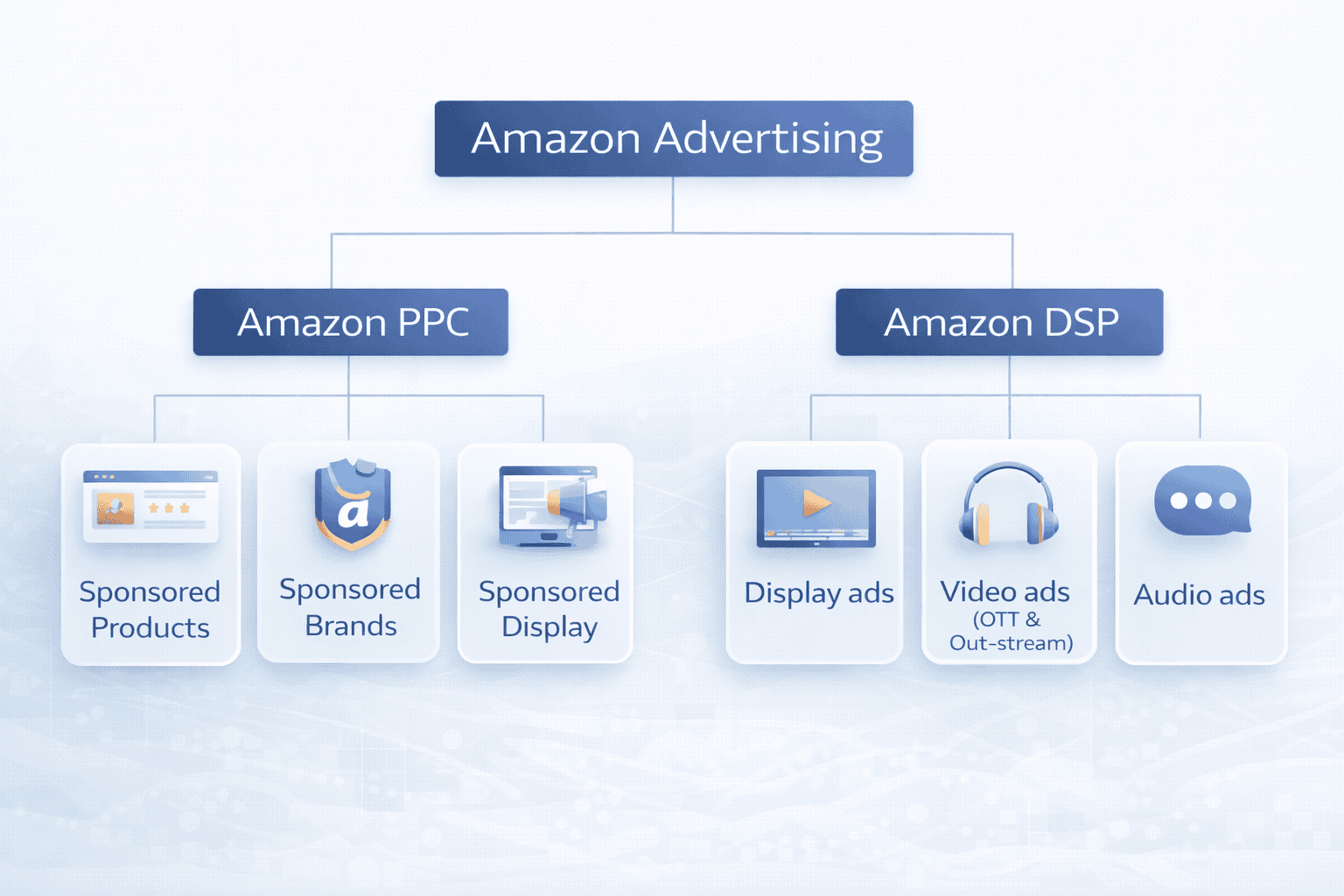
Choosing the right ad format is one of the most important decisions in any Amazon PPC strategy or managed Amazon PPC services engagement. Each format serves a different purpose within the funnel.
Sponsored Products
This is the most familiar ad format on Amazon and, for many advertisers, the starting point. Sponsored Products appear directly inside search results and on product detail pages, placing individual SKUs in front of shoppers who are already comparing similar items.
They work best when the goal is straightforward conversion. These ads capture high-intent traffic at the moment a buying decision is forming. Because spend is tied closely to individual product performance, Sponsored Products often become the core of an Amazon PPC strategy, especially for brands focused on measurable sales rather than broad visibility.
When to use:
- Launching a new product that needs early exposure and initial keyword traction
- Scaling SKUs that already convert consistently and can absorb higher volume
- Capturing high-intent searches linked to specific features or use cases, especially while organic rankings are still settling

Sponsored Brands
Sponsored Brands place a brand logo, a custom headline, and multiple products in a single ad unit. They are designed to support brand recognition and guide shoppers toward a broader product range rather than a single SKU.
This format works best once a brand has established baseline demand for its products. It is particularly useful for reinforcing category presence, protecting branded search terms, and encouraging cross-shopping between related products.
When to use:
- Promoting multiple related products rather than pushing a single SKU
- Holding ground on branded search terms when competitors start bidding
- Directing shoppers to a Storefront or a broader category instead of a product page
Sponsored Display
Sponsored Display works differently from keyword-driven ads. Instead of reacting to what shoppers search for, it follows what they’ve already looked at. It’s often used to re-engage visitors who viewed a product and left without buying.
Additionally, it plays a defensive role, keeping your brand visible when shoppers are comparing alternatives on competing product pages.
When to use:
- Retargeting shoppers who viewed products but did not convert
- Protecting product detail pages from competitor ads
- Re-engaging past purchasers with complementary products
Amazon DSP (Demand-Side Platform)
Amazon DSP enables programmatic advertising both on and off Amazon using advanced audience targeting. It is typically used by larger brands with higher budgets and more complex attribution needs. DSP works best once Sponsored Ads are already profitable.
When to use:
- Scaling reach beyond keyword-based Sponsored Ads
- Building full-funnel awareness for high-lifetime-value products
- Running coordinated campaigns across Amazon and external channels
How to Use Amazon Advertising Strategically
Running ads without a strategy usually leads to inconsistent results. Inflated costs follow soon after. Effective Amazon advertising starts with aligning campaigns to clear business objectives.
Align Campaigns with Business Goals
Different goals require different campaign structures.
Awareness campaigns, for example, focus on exposure and discovery, often using Sponsored Brands or broader keyword targeting. In contrast, conversion campaigns prioritize direct sales and typically rely on Sponsored Products with tighter keyword control. Meanwhile, retention campaigns use Sponsored Display to re-engage past visitors or buyers.
Choosing the wrong ad type for the wrong goal is one of the fastest ways to waste budget.
Targeting and Keyword Strategy
Keyword targeting remains the backbone of how to advertise on Amazon effectively. High-performing accounts use a layered approach.
Broad match keywords are useful for discovery and data collection. Phrases and exact match keywords drive efficiency and predictability. Negative keywords play a critical role by preventing spending on irrelevant or low-intent searches.
Beyond keywords, audience and behavioral targeting can refine reach, especially when combined with Sponsored Display or DSP campaigns.
Budgeting and Bid Management
Budget discipline separates scalable accounts from unstable ones.
Start with a conservative daily digital marketing budget allocation and bids, then scale based on performance metrics such as ACOS and conversion rate. Dynamic bidding options allow Amazon to adjust bids in real time, but they should be used selectively.
Many advertisers group campaigns into portfolios to manage spend by product line or business goal. This structure improves visibility into performance and simplifies optimization decisions.

How to Assess ROI and Spending Efficiency on Amazon
The answer to “How much does it cost to advertise on Amazon?” requires looking beyond headline CPC numbers. Costs vary widely by category, competition, and listing quality.
In many categories, CPCs fall close to the $1 mark, though competitive niches push well beyond that. Costs are influenced by:
- Keyword competition
- Ad placement
- Conversion performance
- Listing relevance

Improving conversion rate often has a greater impact on ROI than lowering bids.
Evaluating ROI and Profitability Metrics
Amazon provides a wide range of performance metrics, yet not all deserve equal weight at every stage.
Advertising Cost of Sales (ACOS) measures ad spend as a percentage of attributed sales. Total Advertising Cost of Sales (TACoS) evaluates ad spend relative to total revenue, including organic sales. ROAS, CTR, and conversion rate provide additional context.
Advanced advertisers often rely on third-party tools such as Helium 10 Adtomic, Jungle Scout, or Perpetua (formerly Sellics) to gain deeper insight and forecasting capability. In addition, PPC audit services can identify inefficiencies and provide actionable recommendations.
Using Budget Allocation Tools for Optimization
Standard spreadsheets and old-school ROI models can only take you so far. When your spend starts to scale, manual tracking usually turns into a headache and loses its accuracy.
That’s where our AI-powered budget planner and calculator comes in. It’s built to give you much sharper numbers and clearer forecasts by analyzing real market data. It takes the guesswork out of the equation, ensuring your budget is actually working for you as your campaigns get more complex.
Structured allocation, including planned rebalancing across campaigns, prevents overspending and ensures capital flows toward the most profitable opportunities. Continuous reallocation is one of the most underused levers in Amazon advertising.
This is also where experienced digital advertising services add value, bringing the structure, oversight, and optimization needed to manage complexity as spend scales.
Data-Driven Strategies to Maximize Amazon Ad ROI
Long-term performance depends on consistent testing, segmentation, and integration with organic growth efforts.
Continuous Testing and Optimization
Regular analysis of search term reports reveals wasted spend and hidden opportunities. Testing new keywords, creative variations, and bid adjustments should be part of a weekly or bi-weekly process.
Over time, small adjustments usually matter more than dramatic resets.
Campaign Segmentation
Segmenting campaigns by product type, margin profile, or intent level improves control. Branded and non-branded keywords should almost always be separated. High-margin SKUs deserve different treatment from low-margin volume drivers.
Integration with Organic Performance
Amazon advertising works best when paired with strong listing optimization. Improved titles, images, and reviews increase conversion rate, which lowers ACOS and improves ad efficiency.
SEO and PPC on Amazon are not separate systems. They reinforce each other.

Measuring Success and Scaling Profitably
Amazon’s attribution tools show you exactly how ad exposure leads to sales, and external analytics platforms give extra insight into performance across all your marketing channels. By tracking the right metrics, you make scaling decisions based on real profit, not just surface-level numbers.
Scaling Strategy
Scaling should follow performance, not ambition. Increase budgets only after campaigns demonstrate stable efficiency. Expanding into Amazon DSP makes sense when Sponsored Ads are already profitable and incremental reach is required.
Balancing short-term profitability with long-term brand growth remains a strategic decision, not a fixed rule.
Common Budget Drains and How to Avoid Them
Certain budget leaks show up again and again across Amazon advertising accounts, regardless of size or category. They rarely stem from overly complex strategy mistakes. More often, they come from gaps in structure and a lack of ongoing attention.
- Overspending on broad or loosely relevant keywords: Broad match campaigns can be useful for discovery, especially early on. The problem starts when they are left unattended. Over time, this inflates spending while depressing overall efficiency. Regular search term analysis is essential to identify irrelevant queries and add them as negative keywords before they accumulate cost.
- Infrequent performance reviews: Amazon advertising is not a “set it and forget it” channel. Competitive pressure, seasonality, and shifts in shopper behavior can change campaign performance quickly. Accounts reviewed only once a month often carry underperforming keywords, bids, or placements far longer than they should. By the time action is taken, inefficiencies have already compounded.
- Weak product listings undermining ad efficiency: Ads can drive traffic, but they cannot compensate for weak product pages. Poor images, unclear titles, thin bullet points, or low review counts reduce conversion rates, which in turn raise cost per acquisition. In these cases, increasing ad spend often worsens performance rather than improving it. Optimizing listings alongside campaigns is a prerequisite for sustainable results.
- Uncapped bids and inactive pruning: Keywords or products that consistently fail to meet efficiency targets should be paused, reduced, or restructured. Leaving underperforming bids active out of habit or uncertainty slowly erodes profitability.
In practice, most budget waste comes from inattention rather than complexity. Simple, consistent review processes prevent the majority of avoidable spend.
Final Thoughts
Amazon advertising rewards structure and patience. Disciplined decision-making is what keeps it profitable. Learning how to advertise on Amazon effectively means approaching it as a system that supports business goals, not as a shortcut to visibility.
Brands that treat advertising as part of a broader commercial strategy tend to outperform those chasing impressions or short-term sales spikes. Aligning campaigns with product margins, maintaining strong listings, and evaluating true ROI creates a foundation for controlled growth.
Visibility can initiate momentum, but profitability sustains it. Businesses that focus on efficiency, data, and long-term signal building are better positioned to scale Amazon advertising without increasing risk or volatility.
FAQ
How Much Does It Cost to Advertise on Amazon?
There is no standard starting cost. Spend depends on how competitive the category is and how aggressively campaigns are managed. Most advertisers work within a cost-per-click (CPC) model and let performance data, not assumptions, determine how budgets evolve.
Which Types of Amazon Ads Have the Best ROI?
Sponsored Products usually generate the strongest returns when the goal is direct sales. They target high-intent searches and tie spend closely to conversions, which makes efficiency easier to control.
How Do I Advertise My Products on Amazon?
Advertising starts by selecting appropriate ad types, defining goals, and building keyword-driven campaigns aligned with margins.
How Often Should I Adjust My Ad Budget?
Daily changes usually create noise. Weekly reviews allow enough data to spot real trends without reacting to short-term volatility.
When Should I Expand to Amazon DSP?
DSP becomes viable once Sponsored Ads are profitable and additional reach or retargeting is required.

