Should we start with some Facebook Messenger marketing stats?
Messenger is the second most popular messaging app after WhatsApp, with over 1 billion monthly active users worldwide. Users aged between 25 and 34 account for about 25% of that user base — making it one of the most valuable channels for reaching Millennial decision-makers.
Facebook Messenger marketing is the practice of using Messenger to send targeted messages, run automated conversations, and deliver ads directly to users’ inboxes, achieving open rates of up to 80%, compared to under 20% for email.
What makes Messenger truly remarkable for businesses?
Open rates as high as 80% and click-through rates reaching 20%. These numbers dwarf email marketing, with open rates below 20% and CTR under 3%, and far outshine the organic reach of posts on Facebook, Instagram, or LinkedIn, which hover around 5–10%.
Messenger is not just another channel; it’s a direct line to your audience that bypasses the algorithm entirely.
Platform Update — April 2026
Meta discontinued the standalone Messenger website, redirecting users to Facebook Messages. Core Messenger marketing functionality — including bots, ads, automated sequences, and direct messaging — remains fully operational within the Facebook app and Facebook.com.
Why Choose Messenger Marketing? 5 Reasons Backed by Data
Not all marketing channels are created equal. Here’s why Facebook Messenger consistently outperforms traditional digital channels and why businesses that adopt it early hold a significant advantage over those that wait.
Massive User Engagement
Messenger boasts a vast global audience with high engagement, offering businesses an unmatched opportunity to reach their ideal customers. With over 1 billion active users, Messenger gives businesses direct access to one of the largest captive audiences on any platform. Unlike social media feeds where posts compete for attention, Messenger delivers your message directly, making every interaction intentional rather than incidental.
Superior Open and Click-Through Rates
Messenger is perfect for delivering high-impact marketing campaigns with 80% open rates and 10x higher CTRs than email. To put that in context: for every 100 people who receive your Messenger message, 80 will open it, and up to 20 will click. Send the same message by email, and you can expect 15–20 opens and 2–3 clicks. The gap is not marginal; it’s transformational for businesses that rely on direct communication to generate leads.
Personalized and Interactive
Messenger’s conversational format allows for highly personalized customer interactions, fostering stronger relationships and trust. Messenger allows you to segment your audience by behavior, purchase history, and preferences, sending the right message to the right person at the right moment. This level of personalization is what separates Messenger marketing from broadcast channels like email blasts or social media posts.
Right Audience
Segment by behavior, interest & history
Right Message
Personalised to each user’s preferences
Right Moment
Triggered by actions, not a broadcast schedule
Cost-Effective Advertising
Compared to traditional advertising channels, Messenger campaigns deliver better ROI with precise targeting capabilities. Click-to-Messenger ads consistently outperform standard Facebook feed ads in cost per lead across industries, including eCommerce, healthcare, and professional services. Because users opt into the conversation, the intent level is higher, meaning lower acquisition costs and better conversion rates downstream.
Direct Access Without Algorithm Interference
Unlike organic Facebook posts, which reach only 5–10% of your page followers due to feed algorithm filtering, Messenger messages go directly to the recipient’s inbox. There is no algorithm deciding whether your message gets seen. If someone subscribed to your Messenger list, they receive your message.
That level of guaranteed delivery is something no other social media channel can offer.
Top Messenger Marketing Strategies & Tactics
The most effective Facebook Messenger marketing strategies combine automation, personalization, and direct response — turning Messenger from a customer service tool into a full revenue channel. Here are the core tactics that deliver results.
Deliver Content To Your Audience
Facebook Messenger gives you a one-to-one channel for delivering content directly to your subscribers, whether that’s new blog posts, product updates, promotions, or educational sequences.Unlike a Facebook feed post that competes with dozens of other pieces of content, a Messenger message lands in a personal inbox and feels intentional.This is what makes Messenger content delivery fundamentally different from social media broadcasting.
You’re not hoping someone scrolls past your post at the right moment. You’re delivering directly, on your schedule, to people who opted in.
Step 1
Segment
Group subscribers by interest, behavior & history
Step 2
Personalise
Tailor each message to the recipient’s preferences
Step 3
Automate
Run drip sequences that nurture leads over time
How to maximise content delivery:
- Segment your audience first: group subscribers by interests, past interactions, and purchase behavior before sending. A promotional message sent to someone who just bought is wasted. The same message sent to a warm prospect converts.
- Personalise every message: include the user’s name, reference their last interaction, or tailor the content to their stated preferences. Personalisation in Messenger increases CTR by up to 3x compared to generic broadcasts.
- Use drip campaigns: automate sequences of messages that nurture leads over time rather than sending one-off blasts. A 5-message drip sequence over 7 days consistently outperforms a single promotional message.
Industry example: A SaaS company used Messenger drip campaigns to onboard new trial users, covering key features across 5 messages over 7 days. Trial-to-paid conversion increased by 30% compared to their previous email-only onboarding flow.
Build Relationship With Your Customers
The highest-value use of Messenger marketing isn’t selling, it’s reducing friction at every stage of the customer journey. Appointment reminders, event follow-ups, post-purchase check-ins, and re-engagement sequences all perform significantly better on Messenger than email because the channel feels personal rather than automated.
Where Messenger relationship-building works best:
- Appointment and event reminders: send automated reminders 24 hours and 1 hour before any booking, webinar, or demo. Businesses using Messenger reminders report no-show reductions of 30–40%.
- Post-purchase follow-up: check in after a purchase with a usage tip, a satisfaction question, or a relevant upsell. The open rate means your message will almost certainly be seen.
- Re-engagement sequences: reach subscribers who haven’t interacted in 30–60 days with a relevant offer or content piece before they go cold permanently.
- Seasonal and promotional updates: new collections, limited-time deals, and holiday promotions perform exceptionally well in Messenger because of the direct delivery and high open rates.
🔔
Appointment Reminders
30–40% fewer no-shows with automated 24hr & 1hr reminders
🛍️
Post-Purchase Follow-Up
80% open rate ensures your follow-up is almost always seen
🔁
Re-Engagement Sequences
Reach inactive subscribers at 30–60 days before they go cold
📣
Seasonal Promotions
Direct delivery and high open rates make Messenger ideal for time-sensitive offers
Industry example: A dental clinic reduced no-shows by 40% using automated Messenger appointment reminders sent 24 hours and 1 hour before each booking, replacing a manual phone call process that consumed 2 hours of staff time per day.
Use FAQ Chatbot to Engage With Customers 24/7
Facebook Messenger chatbots handle customer queries instantly, at any hour, without staff involvement. For businesses that receive repetitive questions about pricing, availability, shipping, or bookings, a well-built chatbot eliminates the bottleneck entirely while improving response time and customer satisfaction simultaneously.
What a Messenger chatbot can do:
- Respond to common FAQs instantly with accurate, pre-approved answers
- Qualify leads by asking screening questions before passing to a human agent
- Send automated marketing messages — product announcements, special offers, follow-up sequences
- Track engagement and conversation data to refine messaging over time
- Escalate complex queries to a live agent when needed
79% of consumers prefer live chat because it offers instant responses. 41% consider it their top channel for contacting support. Messenger chatbots deliver the same instant-response experience at scale — without the staffing cost.
Top Messenger chatbot tools:
- ManyChat: the most widely used Messenger bot platform. Drag-and-drop flow builder, strong eCommerce integrations, free plan available. Best for: small to mid-size businesses getting started with automation.
- Chatfuel: no-code chatbot builder with powerful audience segmentation. Ideal for businesses running high-volume Messenger campaigns across multiple funnels.
- MobileMonkey: multi-channel coverage across Messenger, SMS, Instagram, and web chat from a single platform. Best for: businesses wanting one tool to manage all messaging channels.
Industry example: An eCommerce brand implemented a Messenger chatbot to handle order tracking queries, reducing support tickets by 60% and freeing the customer service team to focus exclusively on complex issues.
Try Facebook Messenger Ads
Messenger ads are among the highest-intent ad formats available on Meta’s platforms, because they initiate a conversation rather than directing users to a landing page. When someone clicks a Messenger ad, they’re actively choosing to engage with your brand. That intent level is significantly higher than a passive scroll-past on a feed ad.
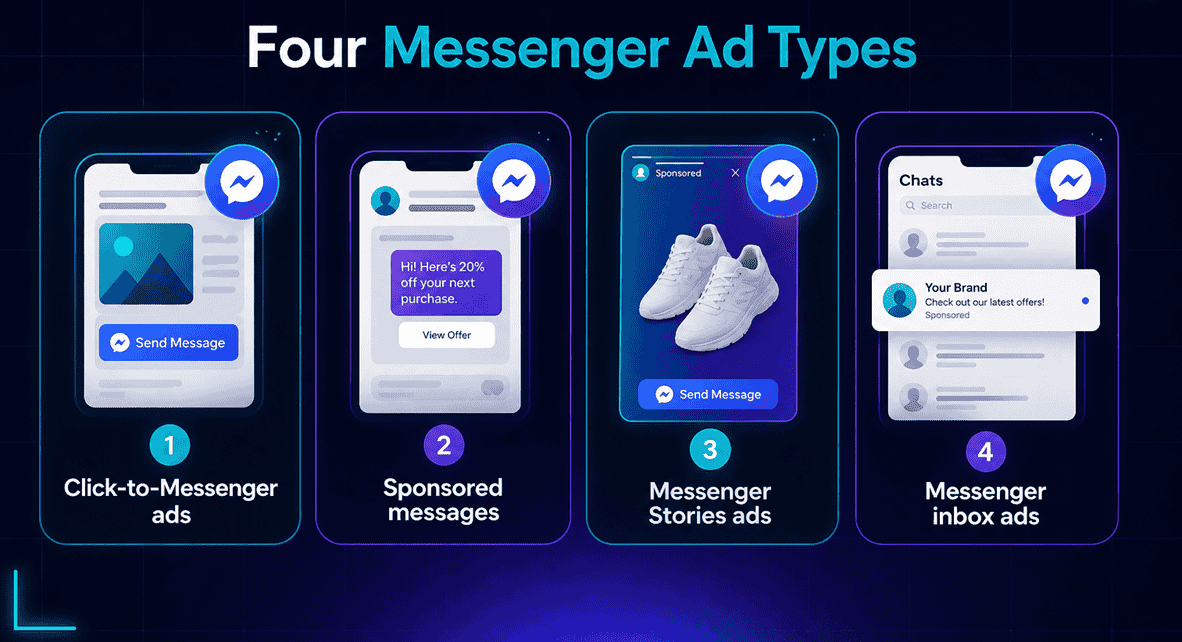
There are four Messenger ad types to know:
- Click-to-Messenger ads — standard feed or Stories ads with a “Send Message” CTA. The user clicks and a Messenger conversation opens automatically. Best for: lead generation, appointment booking, product enquiries.
- Sponsored messages — ads sent directly to users who have previously messaged your business. Best for: re-engaging warm leads and existing customers with offers or updates.
- Messenger Stories ads — full-screen vertical ads that appear between Messenger Stories. Best for: brand awareness and reaching a broad Messenger audience.
- Messenger inbox ads — ads that appear in the Messenger home tab between conversations. Best for: retargeting users already active in Messenger.
To get the most out of Messenger ads, keep these best practices in mind:
- Set a clear objective before launching — lead generation, retargeting, and brand awareness each require a different ad type and bidding strategy
- Use custom audiences to target users who have already interacted with your business on Facebook or Messenger
- Write your opening message carefully — the first line a user sees after clicking determines whether they engage or close the conversation
- Always have a chatbot or live agent ready to respond — a Messenger ad that opens to no reply kills the conversion immediately
Industry example: A B2B software company ran Click-to-Messenger ads targeting decision-makers on Facebook. Cost per qualified lead was 3x lower than their standard lead form campaigns — because the Messenger conversation allowed instant qualification before the lead was passed to sales.
Use Messenger for Audience Segmentation & Targeting
Not all Messenger subscribers are the same — and treating them as if they are is the fastest way to destroy engagement and trigger opt-outs. The businesses that get the most out of Messenger marketing segment before they send.
Key segmentation approaches:
- By behavior: separate subscribers who clicked a product link from those who only opened. Send follow-up content based on what they actually did, not what you hoped they’d do.
- By purchase history: target repeat buyers with loyalty offers and new subscribers with introductory content. Never send the same promotional message to both groups.
- By preferences: use a simple chatbot question sequence during the opt-in flow to let subscribers self-select the content they want. Preference-matched messages consistently outperform generic broadcasts.
- By funnel stage: cold leads, warm prospects, and existing customers all need different messaging. Map your Messenger sequences to your actual sales funnel, not a one-size broadcast schedule.
How to set up segmentation in practice:
- Use tags in ManyChat or Chatfuel to label subscribers based on their actions — a click, a purchase, a specific reply
- Build separate sequences for each segment rather than sending everyone the same drip campaign
- Review segment performance monthly: open rates, CTR, and opt-out rates by segment tell you exactly where your messaging is working and where it isn’t
The businesses that master Messenger segmentation turn it into a precision revenue channel. Those that don’t eventually see engagement drop and unsubscribe rates climb — and blame the platform rather than the strategy.
Messenger Marketing Beyond Facebook: WhatsApp & Instagram
Facebook Messenger isn’t the only messaging channel worth automating. WhatsApp and Instagram DMs follow the same core principles: segmentation, personalization, and automated sequences, but with platform-specific mechanics businesses need to account for.
WhatsApp Business API: Unlike Messenger, WhatsApp requires opt-in through a documented business-initiated messaging framework, and conversations outside a 24-hour customer service window incur template-message costs. That makes WhatsApp better suited to transactional and support-driven use cases, such as order updates, appointment confirmations, and shipping notifications, rather than broad promotional broadcasts. [Data needed: current WhatsApp Business API pricing/engagement benchmarks before publishing.]
Instagram DMs: Instagram automation runs through the same Meta Business Suite infrastructure as Messenger, so click-to-DM ads, saved replies, and basic chatbot flows built for Facebook can largely be mirrored on Instagram with minimal rebuild. The audience skews younger and more visual, and DM automation here performs best when triggered by Story replies, comment-to-DM sequences, and post engagement rather than cold outreach.
Choosing a channel: Most businesses don’t need to pick just one. The stronger approach is mapping each channel to where the audience already is: WhatsApp for service-heavy, high-trust interactions, Instagram for top-of-funnel engagement and younger demographics, and Facebook Messenger for the deepest ad integration and most mature automation tooling, which is why the rest of this guide focuses there.
How to Use Facebook Messenger as a Marketing Channel: Getting Started
Setting up Facebook Messenger marketing doesn’t require a large budget or a dedicated tech team. What it does require is a clear plan — covering your opt-in strategy, your first automation sequence, and how you’ll handle replies. Here’s how to get started.
Platform Update
Since April 2026, Messenger is accessed exclusively through the Facebook app or Facebook.com — the standalone messenger.com website has been discontinued. Business Page inbox management, bot integrations, and ad campaigns are all unaffected.
Step 1: Set Up Your Facebook Business Page Inbox
Before running any Messenger campaign, ensure your Business Page inbox is fully configured. Set your response time expectation, write a Page greeting that appears when users first open a conversation, and set up an instant reply for when your team is offline. These three settings alone significantly improve first impressions and opt-in rates.
Step 2: Build Your Messenger Subscriber List
Unlike email, Messenger subscribers must actively opt in to receive messages from your business. The most effective opt-in methods are:
- Facebook comments growth tools, when a user comments on a specific post, they automatically receive a Messenger message and become a subscriber
- Click-to-Messenger ads, paid ads that open a Messenger conversation directly
- Website chat widgets, embed a Messenger chat plugin on your site to convert web visitors into Messenger subscribers
- QR codes, link a Messenger conversation to any physical or digital touchpoint
Step 3: Create Your First Automated Sequence
Start with a welcome sequence — a series of 2–3 messages sent automatically when someone subscribes. The welcome sequence should: introduce your brand, set expectations for what subscribers will receive, and include one clear call to action. Keep it conversational, keep it short, and resist the urge to sell in the first message.
Step 4: Set Up a Basic FAQ Chatbot
Before investing in a full chatbot build, start with the 5 questions your team answers most often. Build a simple decision-tree chatbot in ManyChat or Chatfuel that handles those 5 queries automatically. This alone will reduce your inbox volume and ensure subscribers get instant responses at any hour.
Step 5: Launch Your First Messenger Ad
Once your inbox is set up and your welcome sequence is running, launch a Click-to-Messenger ad to a warm custom audience — people who have visited your website or engaged with your Facebook page in the last 30 days. This is the lowest-risk entry point into Messenger advertising because you’re reaching people already familiar with your brand.
Step 6: Monitor, Test, and Optimise
Track open rates, CTR, opt-out rates, and conversion rates weekly for the first month. The biggest gains in Messenger marketing come from iteration — testing different message timings, subject lines, and CTAs until you find what resonates with your specific audience.
Work With a Messenger Marketing Agency
Facebook Messenger marketing delivers results, but only when the strategy, automation, and ad campaigns are built correctly from the start. Most businesses that try Messenger marketing in-house hit the same three obstacles: low subscriber growth, poor chatbot flows that frustrate users, and Messenger ads that spend budget without converting.
Working with a specialist Messenger marketing agency eliminates all three.
What a Messenger marketing agency handles:
- Strategy & audience mapping — identifying the right Messenger touchpoints across your customer journey and building sequences that match each stage
- Chatbot design & setup — building conversation flows that qualify leads, answer FAQs, and escalate to human agents at the right moment
- Click-to-Messenger ad campaigns — creating, launching, and optimising ads across cold, warm, and retargeting audiences
- Subscriber list growth — deploying opt-in tools across your website, social channels, and paid campaigns
- Performance reporting — tracking open rates, CTR, opt-out rates, and conversion data with transparent monthly reporting
At Andava Digital, we build and manage Messenger marketing programmes as part of a broader suite of Facebook marketing services, not as a standalone tactic. Google Premier Partner. 15+ years. 25+ industries.