

I have great news: perfect content doesn’t exist. Okay, I know what you’re thinking. How could that possibly be good news? Well, in the vast sea of competitors fighting to appear first on result pages, there is at least one key SEO or GEO touchpoint you can outperform all of them at. Content gap analysis reveals those touchpoints.
For businesses aiming to reach the top tier of authoritative sources in their niche, the key is to find out what they’re not doing well enough. Once you know how to identify the gaps in your content, you’ll be armed and ready to take on the top pages.
What Is Content Gap Analysis?
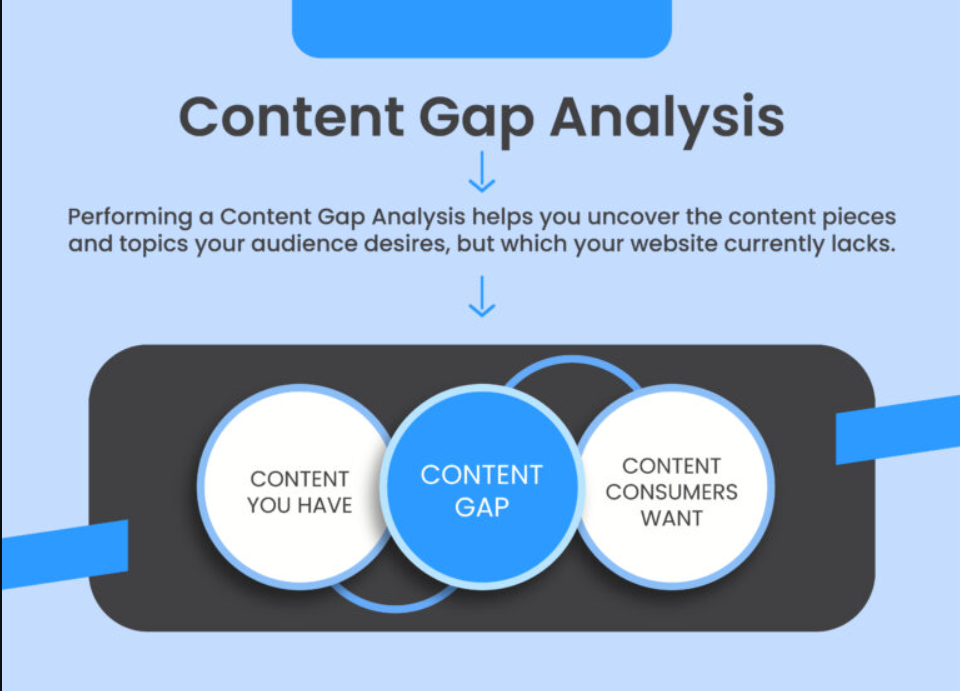
Content gap analysis is the process of identifying missing content opportunities by comparing your website’s SEO and GEO techniques to your top-rated competitors. This analysis removes the guesswork and tells you the specific topics and content formats where your competitors are getting the edge over you.
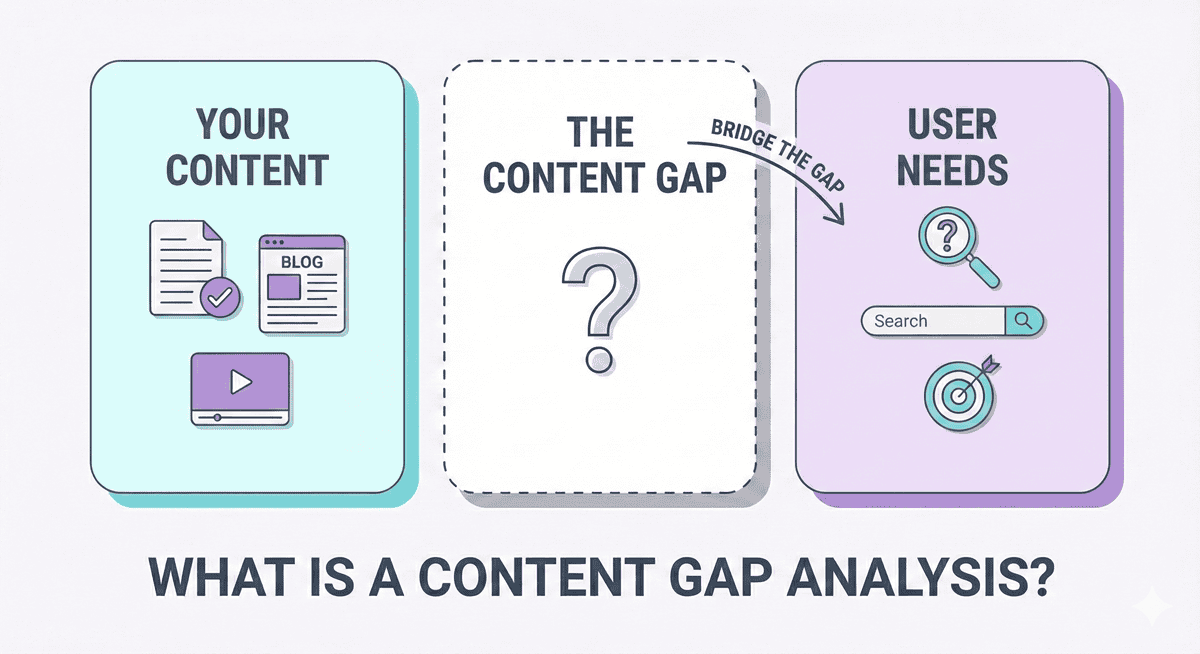
Now, many content leads make the mistake of carrying out just keyword analysis in an attempt to catch up. What they don’t understand is that there’s a major difference between keyword gap vs content gap.
- Keyword Gap Analysis focuses on finding specific keywords or search terms your competitors rank for, but you do not.
- Content Gap Analysis is broader, and asks: “What topic, audience need, or stage of the buyer’s journey is missing from our current content library?” A single content gap can cover dozens of missing keywords.
This is exactly why learning how to do a content gap analysis is so important. It goes beyond simple keyword comparison to ensure your library provides complete, authoritative coverage.
Why Conduct a Content Gap Analysis?
A content gap analysis helps you ensure you’re not just walking into a blind alley with your content. Instead, you’re responding directly to what your audience searches for and what your competitors already rank for. So, what measurable results can you expect?
When I do a content gap analysis, I’m not just checking missing keywords. I look for missing answers.
👉 What questions are your users still asking after reading your page?
👉 Which problems aren’t being solved completely?— Ankit Prajapati (@consultantankit) October 31, 2025
- Boost Visibility and Organic Traffic: When you target keywords your competitors rank for, and you don’t, you’re creating new channels for your customers to find your business. Each content gap you fill represents a new opportunity for your website to appear in search results and bring qualified traffic that’s searching for the solutions you provide.
- Capture Competitor Traffic and Market Share: Your high-ranking competitors already show the results and content your audience wants to see. If a competitor is ranking for a high-value keyword, a content gap analysis identifies the missing article, guide, or tool you need to challenge them directly.
- Improve Content Efficiency and Effectiveness: Gap analysis ensures every piece you create serves a specific purpose. This focused approach increases your marketing ROI by focusing resources on opportunities with proven search demand instead of aiming at speculative topics that may never attract traffic.
- Align content with different buyer journey stages. Thorough analysis shows where you’re missing content for specific stages of the customer journey. You might, for example, have plenty of awareness-stage content, but lack the comparison guides and case studies that convert consideration-stage prospects. Content mapping through gap analysis helps you support customers at every touchpoint.
How to Do an SEO & GEO Content Gap Analysis
The way businesses approach this proccess has changed since the emergence of generative AI engines. The focus of traditional SEO was to rank on traditional search engines organically. But today, understanding how to do an analysis means mastering two different, but complementary methods.
SEO Content Gap Analysis
Traditional analysis focuses on improving visibility in conventional search engines like Google and Bing, where rankings determine which websites users discover. Let’s take a look at what makes up a great SEO gap analysis.
- Map competitor keywords and landing pages: The SEO method centers on keyword gap analysis to find competitor keywords you aren’t targeting yet. Tools like Semrush Keyword Gap, Ahrefs Content Gap, and Moz Keyword Explorer allow you to compare your domain with other competitors to reveal missing keyword opportunities.
- Filter out low-quality keywords: When conducting an SEO content gap analysis, focus on filtering for volume, difficulty, and relevance to avoid wasting resources on low-value keywords. Ideally, a new website with less authority should target lower-difficulty keywords despite potentially smaller search volumes. In the meantime, established sites can pursue more competitive terms with higher traffic potential.
- Assess on-page and backlink gaps: Success in traditional SEO means optimizing content for crawlability through a proper technical structure, building high-quality backlinks that signal authority, and maximizing user engagement metrics that show content value.
- Measure your success: Gauge your progress by tracking ranking changes, organic sessions, and on-site conversions like form fills and demos after publishing or refreshing content.
GEO Content Gap Analysis
Traditional SEO optimization is still important, but the rise of AI-powered search engines and generative platforms like ChatGPT and Perplexity has created an entirely new frontier. In fact, about 60% of Google searches that also include an AI summary end without a click because AI shows instant results. So, what does the ideal process of GEO content gap analysis look like?
- Map LLM prompt visibility: Identify LLM prompts where competitors appear in AI-generated responses but your brand doesn’t. Unlike traditional search, where rankings determine visibility, generative engines collate information from multiple sources to create direct answers, making citation frequency the new currency of digital visibility.
- Utilize AI-oriented toolkits: AI SEO toolkits allow you to track prompt visibility and monitor brand mentions across AI platforms. These tools reveal which topics generate AI responses that cite your competitors while completely ignoring your content, highlighting clear opportunities to adjust your content strategy.
- Optimize for clear and direct content: GEO requires structuring content for machine readability with clear headings and schema markup, providing fact-based answers that AI models can confidently cite, and ensuring your content is conversational yet authoritative.
- Track AI citations: Measuring GEO success is different from traditional SEO. Citation frequency in AI responses, share of AI voice within your industry, and AI-referred traffic become your primary KPIs.
Core Steps to Conduct Content Gap Analysis (Applicable to SEO & GEO)
One big mistake businesses make when trying to close the gap on their competitors is thinking a simple Google first page search holds all the answers they’re looking for. That’s an important step, sure, but it’s also just a fraction of the process. Let’s walk step-by-step through what real content gap analysis entails.
- Step 1: Identify Your Competitors: Start by determining both your commercial competitors (companies offering similar products or services) and your organic search competitors (websites that outrank you for target keywords). Using an SEO toolkit can help you find domains with similar keyword profiles, as well as significant traffic overlap with your market.
- Step 2: Perform Keyword Gap Analysis: Identify up to four competitors using a keyword gap tool and study their top-performing content. Which topics are they dominating? Which high-intent keywords are they capturing that you are not? Where are the opportunities to capitalize on low-competition keywords? To address these matters, filter your results by search volume, keyword difficulty, and relevance to prioritize the most valuable targets.
- Step 3: Discover Topic and Format Gaps: Beyond individual keywords, study the broader topics your competitors cover that you’ve ignored. Do they have how-to guides, comparison articles, or video content that’s driving engagement? Also, identify format gaps where competitors use infographics, videos, or interactive tools that resonate with your shared audience.
- Step 4: Audit Your Existing Content for Quality and Performance Gaps: Run a content audit to find out which of your formerly high-performing pages have declined in traffic. Then compare the content on those pages with the top-ranking competitor pages. Sometimes you might not need new content at all; just a significant improvement to what you already have.
- Step 5: Leverage Audience Insights and Voice of Customer Research: Ideally, gap analysis shouldn’t rely on just your competitors’ data. You should also survey your customers, analyze support tickets, and dig through social media discussions to find pain points that even your competitors don’t properly address. That represents an opportunity to establish yourself as a content leader.
- Step 6: Analyze Search Engine and AI Content Results: Manually check what actually ranks on page one for your target keywords. What makes these results successful? Then check how AI engines respond to relevant queries. Which sources do they cite? This analysis provides context that keyword data can’t.
- Step 7: Create a Roadmap and Execution Plan: Organize all your research into a content calendar that accounts for keyword difficulty, business value, and resource requirements. Also, assign responsibility for creating or updating content to fill content gaps, establish timelines, and define success metrics for each piece you publish.
Examples: What This Process Reveals
A SaaS company offering project management software conducted a content gap analysis against competitors like Asana, Zoho, and Trello. The analysis revealed they had strong content around “project management best practices” but were completely missing keywords like “project management software for remote teams,” “agile project management tools,” and “project management automation.”
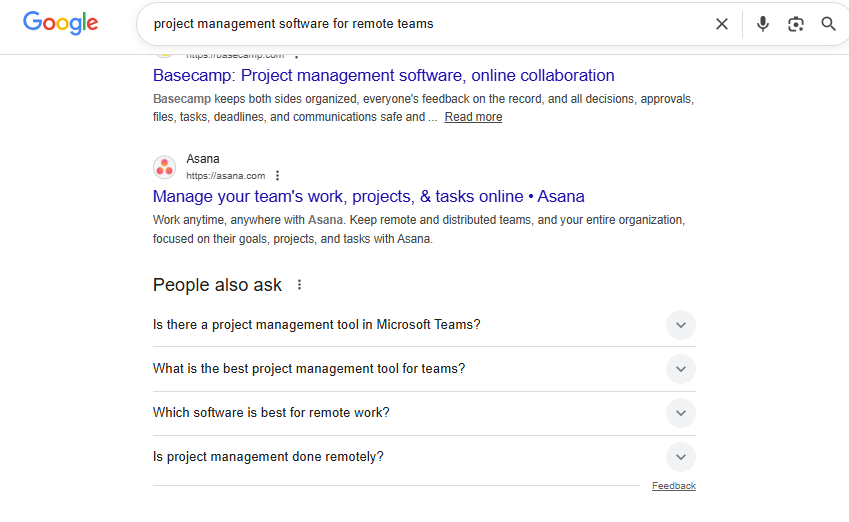
These revealed hundreds of monthly searches from their exact target audience that competitors were capturing, and they weren’t.
The analysis also uncovered missing topic gaps. Competitors had detailed comparison pages and integration guides that drove significant decision-stage traffic. Meanwhile, the company’s blog consisted primarily of general tips rather than product-focused content that converts prospects.
It was also established that competitors produced video tutorials, interactive demos, and downloadable templates, while the company only published text articles. They were missing opportunities to engage different learning styles and capture traffic from YouTube and other video platforms.
Tools and Resources to Simplify Content Gap Analysis
Content gap analysis is only as powerful as the data that drives it. While manual research has its place, modern SEO and GEO need advanced toolsets to process the large amounts of competitive and performance data available.
SEO Keyword & Competitor Analysis Tools
These tools provide advanced SEO services that help you identify key areas where you can close the gap on your competitors.
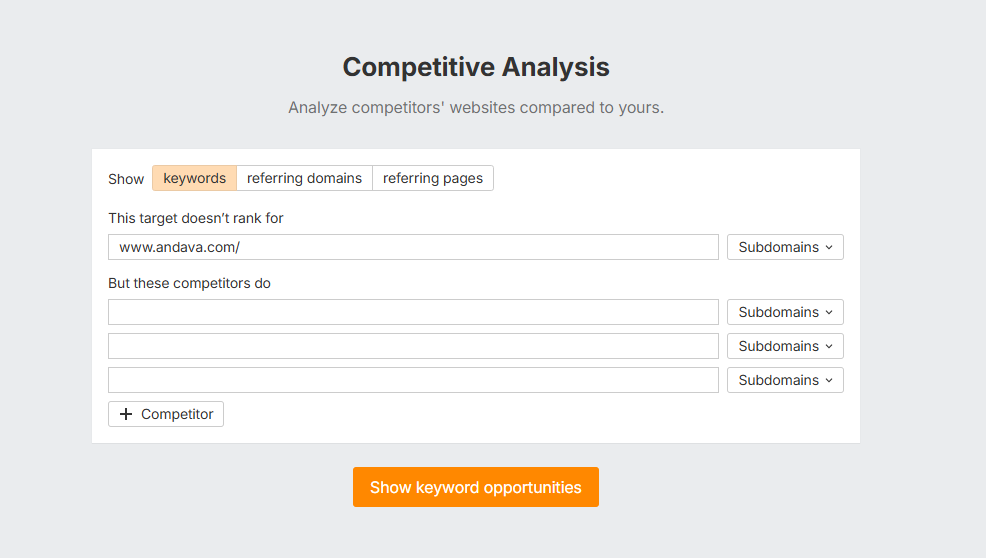
- Semrush Keyword Gap Tool: Semrush’s keyword gap tool enables you to compare up to five domains and filter results by dozens of criteria, including keyword difficulty, search volume, position, and SERP features. The platform automatically categorizes keywords as missing, weak, strong, or untapped based on your comparative rankings.
- Ahrefs Content Gap: Ahrefs offers a slick interface specifically designed for identifying keywords that multiple competitors rank for but you don’t. The tool excels at finding low-hanging fruit opportunities where you can realistically compete, and allows URL-level comparison for analyzing specific pages rather than entire domains.
- Moz Keyword Explorer: Moz provides insights into keyword opportunities and difficulty scores, with particularly strong data for understanding search intent and prioritizing terms most likely to drive conversions. The platform’s Keyword Difficulty metric helps you avoid targeting terms that would need resources beyond your current capacity.
- SpyFu Kombat: SpyFu is great for competitive keyword comparisons with a focus on both organic and paid search opportunities. It’s particularly useful for understanding the complete competitive landscape, including PPC strategies that reveal which keywords competitors consider valuable enough to bid on.
AI & GEO Prompt Visibility Platforms
Generative engine optimization services are quickly growing in importance, with ChatGPT alone reaching 800 million users this year. With these tools, you can ensure your content can compete with top pages.
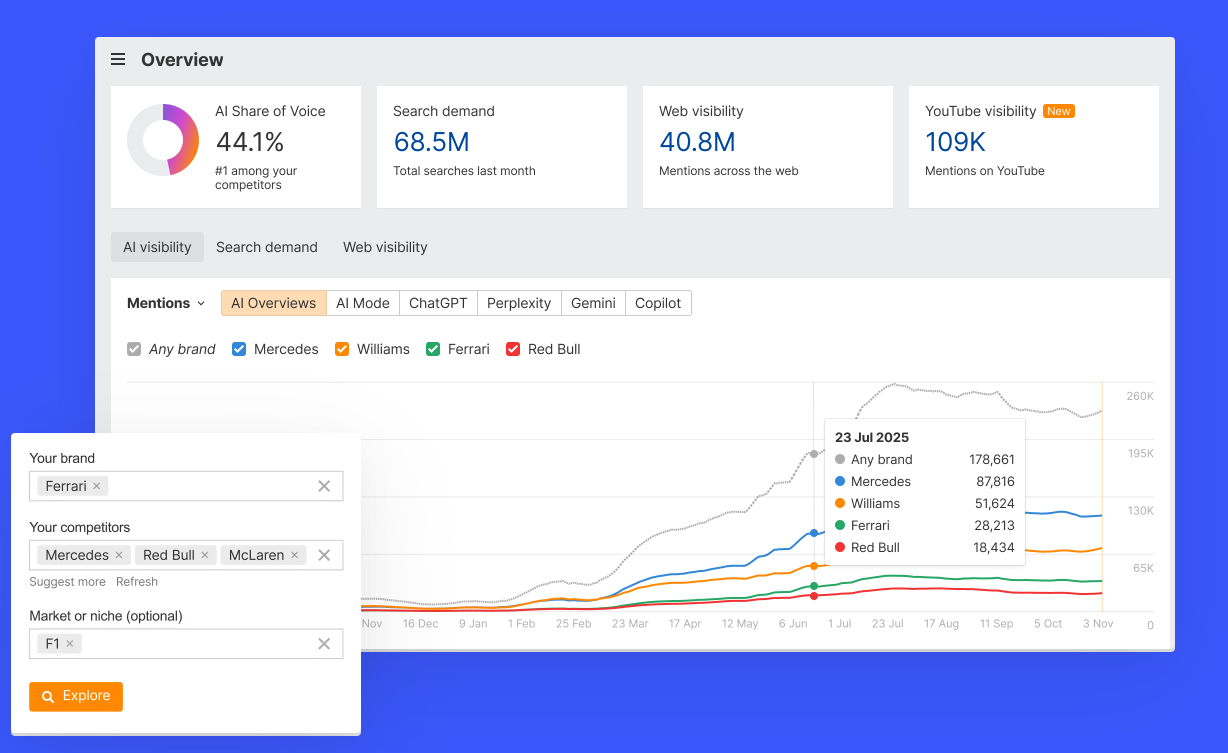
- Semrush AI SEO Toolkit: With its AI SEO toolkit, Semrush helps you track your brand’s visibility across LLMs, showing which prompts mention your competitors but not you. The platform provides specific recommendations for optimizing content to improve citation rates in AI-generated responses.
- Specialized GEO analysis tools: Peec AI, Otterly AI, and Writesonic are great examples of tools that have emerged to help brands monitor and optimize their presence in generative engine results. These platforms track citation frequency across multiple AI platforms and alert you when competitors gain visibility advantages.
- Brand Citation Monitoring: Ahrefs’ Brand Radar and Semrush’s emerging AI modules track brand mentions specifically within new generative search features. This helps identify which competitor is being cited over you for critical topics, representing an authority gap that must be filled.
Content Performance and Analytics Tools
A content gap analysis should not only look outward at competitors but also inward at your own existing content. These tools help you do exactly that.
- Google Analytics 4: The Google Analytics 4 tool reveals which content drives traffic, engagement, and conversions, helping you identify high-performing pieces worth expanding and underperforming content that needs improvement. The platform’s exploration reports enable custom analyses comparing organic traffic trends over time.
- Google Search Console: Google’s search console also provides invaluable data about keyword performance and index status, showing which queries generate impressions but low click-through rates and which keywords are gradually losing visibility to competitors.
- Automated Content Audit Tools: Tools like Screaming Frog and Sitebulb crawl your website to find technical SEO gaps, including missing title tags, thin content, duplicate pages, and crawlability issues that might be preventing your content from ranking, regardless of its quality.
Final Thoughts
Content gap analysis is not a one-time project. It’s an important, recurring process that drives every element of a successful digital strategy. By embracing a content strategy that targets both foundational SEO services and forward-looking GEO strategies, you transform a passive content library into a powerful, competitive asset.
The competitive advantages add up over time as you claim keyword territory and establish topical authority that both traditional search engines and AI models recognize. Start by conducting a thorough analysis of your current content gaps, prioritizing the opportunities with the clearest paths to ROI, and commit to an ongoing process of gap identification and resolution.
Serious about establishing search dominance? Partner with a professional digital marketing agency that provides the deep technical and strategic analysis needed to identify not just keyword gaps but also the technical and structural issues. This will help your content from reaching its full potential.
